



Agroforestry Systems: when food production learns from the forest
Oct 2, 2026
For decades, conventional agriculture has been based on a simple principle: isolating a single crop in a single field and optimising everything for that crop — soil, water, nutrients, plant protection — exclusively for that crop. It has worked, and continues to work, in terms of immediate productivity. But the cost has been mounting in an increasingly visible way: compacted soils depleted of organic matter, growing dependence on fertilisers and pesticides, greater vulnerability to droughts and heatwaves, and a silent erosion which, year after year, is reducing the topsoil layer and sapping the land’s fertility.
It is against this backdrop that an increasing number of organisations concerned with soil health, notably the Save Soil Movement, have been promoting agroforestry as an alternative or complement to traditional agriculture.
What changes with agroforestry
Unlike monoculture, an agroforestry system combines trees, shrubs and annual crops in the same space, mimicking the processes that occur naturally in a forest ecosystem. The most significant advantages of this production model include:
For the soil
• An increase in organic matter, through the foliage and biomass of trees that fall to the ground and decompose, promoting greater carbon sequestration in biomass and soil, leading to a gradual increase on the quantity of available nutrients and, consequently, of the soil fertility;
• Reduced erosion, thanks to permanent vegetation cover and the deep roots of trees that stabilise the soil, preventing it from being washed away by rain and eroded by the wind;
• Increased biological activity — more mycorrhizal fungi, earthworms, beneficial microorganisms and a diverse range of soil fauna;
• Greater water retention in the soil and reduced soil compaction;
For nutrients
• Deep recycling: trees, through their deep roots, bring nutrients from deeper layers to the surface;
• Nitrogen fixation, when leguminous species are included in the system design;
• Reduced leaching and increased nutrient cycling;
For the ecosystem and for the business
• Greater biodiversity, with more habitats for pollinators and natural pest predators, which increase the resilience of the system as a whole;
• More stable microclimates, with trees reducing temperature and wind speed, whilst also reducing plant evapotranspiration;
• Diversification of production, reducing the economic risk associated with monoculture;
The trade-off is well known: agroforestry requires more planning, greater technical expertise and a longer time horizon until the trees reach productive maturity, which are the main reasons why many farmers are reluctant to adopt it.
A transitional approach: alley cropping
One of the most accessible agroforestry systems for those coming from conventional agriculture is alley cropping.
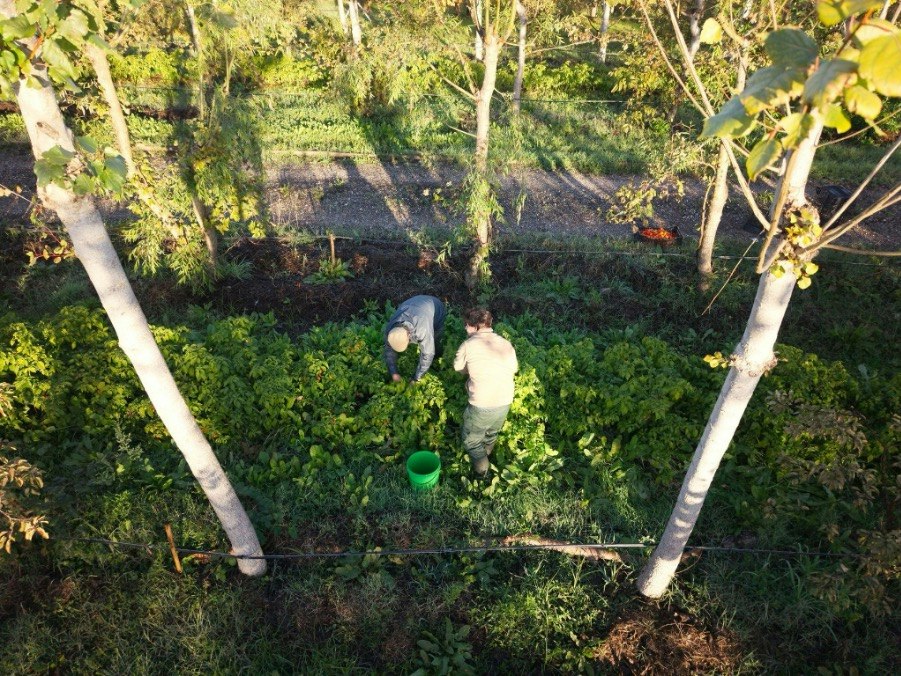
The principle is simple: rows of trees or shrubs are planted at regular intervals, and in the alleys between them, annual crops like cereals, vegetables and pulses, are grown.
This model allows for the continued partial mechanisation of agricultural operations, generates income from annual crops whilst the trees are still young, and progressively provides protection from wind and shade, as well as nutrient recycling, as the trees grow. In practice, it acts as a bridge between the conventional model and a more complex agroforestry system.
It was precisely this approach, combined with the methodology of syntropic agriculture, that a Portuguese company decided to apply to a crop not usually associated with this type of system: peppers for industrial use.
The case of Casa Mendes Gonçalves, in Golegã, Portugal
In Golegã, a region historically characterised by extensive monocultures, Casa Mendes Gonçalves which also has a foundation dedicated to the promotion of sustainable farming, decided to try something rather unusual: growing peppers for its industrial operations using an agroforestry system known as ‘alley cropping’, applying principles of syntropic agriculture inspired by the work of Ernst Götsch.


The initial reaction, even within the company itself, was one of bewilderment. Seeing annual crops growing between rows of trees, in an area accustomed to open fields and conventional crop rotations, raised doubts as to whether it would even be possible to maintain productivity year after year with peppers grown in this way. The very complexity of the system made it difficult to categorise it in familiar terms — neither visitors nor the team themselves could quite define whether it was an orchard or a forest.
As the land selected for the project had a history of intensive maize monoculture, with a soil organic matter content of less than 1 per cent, it was necessary to select the tree species to be used in light of this circumstance.
Thus, in the initial phase, priority was given to species adapted to difficult conditions, capable of promoting soil decompaction and mobilising nutrients from deeper layers. For this reason, eucalyptus was chosen, amongst other species, for its ability to tolerate the poor initial soil conditions, promoting soil decompaction and bringing nutrients available at depth closer to the surface. Alongside this species, poplars and casuarinas were also planted, with American oak, French oak, cork oak and holm oak subsequently being introduced in later succession cycles.


Pruning to coordinate light and plant development
Pruning is a central management practice in syntropic agriculture. Rather than allowing the tree canopy to develop unchecked, its growth is actively managed in relation to the phenological stages of both the trees and the crops growing beneath them.
In this case, the rows of trees are extensively pruned in late winter, so that the opening of the canopies coincides with the onset of spring and provides adequate light for the flowering of the pepper plants beneath them. As the season progresses, canopy regrowth coincides with fruit development and ripening, providing increasing shade when it is most beneficial for temperature regulation and protection against sunscald.

The removed branches are shredded on site, producing wood chips which are then incorporated directly into the rows where the peppers will be planted. In this way, pruning simultaneously regulates light availability and returns the biomass produced by the trees to the soil in a concentrated form.


Shade as an alternative to protective covers
In conventional monoculture systems, protection against sunscald and frost often involves the installation of artificial covers, which entail high costs per hectare and offer no ecological benefit. In the agroforestry system implemented by Casa Mendes Gonçalves, it is the tree canopy itself that fulfils this role — creating shade that protects the crop, whilst providing the ecological benefits that an artificial cover can never offer.
A microclimate that also benefits those working in the fields
This shade has an effect that goes beyond protecting the crop. As this is a summer crop, with harvest periods coinciding with the hottest weeks of the year — Golegã often records temperatures close to 45 degrees Celsius — the working environment under the trees is far more comfortable than in a field fully exposed to the sun.

Company officials also highlight a more structural difference: whilst in a monoculture system the farmer is entirely at the mercy of the weather conditions during the growing season, an agroforestry ecosystem creates its own microclimate, which provides some leeway and protection against extreme weather events. They acknowledge that it is a system that requires more work but one that opens up possibilities which, outside this model, simply do not exist.
Soil fertility figures
One of the most telling indicators of this whole process is the change in the levels of soil organic matter. Six years ago, the field in question contained 0.8 per cent organic matter. Today, thanks to frequent pruning and the systematic incorporation of the resulting prunings into the soil, this figure has risen to 3.7 per cent in the crop rows.


This change has direct practical consequences:
Reduced soil compaction;
Higher rates of water infiltration and retention;
Significant savings in irrigation water, as the young, light shade provided by the trees reduces evapotranspiration – a particularly relevant factor in the context of extreme summers such as those experienced in Golegã, Portugal;
No phytotherapeutic treatments for over three years, with no need for additional products to maintain crop fertility;
Visibly darker and less compact soil, according to the team’s direct observations in the field;
Economic viability: the missing piece of the puzzle
All these environmental benefits would have little practical impact, if they were not accompanied by economic viability. This was, in fact, the company’s main concern at the start of the process: would it be possible to maintain competitive levels of productivity compared with conventional agriculture?
The data collected has consistently come close to the per-plant productivity levels achieved in more intensive farming systems — a result the company considers essential, as without economic competitiveness it would not be possible to continue producing to supply its own large-scale industrial operations.


The company’s CEO, Carlos Gonçalves, sums up this conclusion succinctly: with the agroforestry cultivation of peppers already yielding tonnes for the company’s operations, they consider it to have been conclusively demonstrated that the notion that it would not be possible to produce profitably in these systems or that investing in them would mean compromising food production, it is a false one.
Contrary to what common intuition might suggest, the intercropping of various species does not harm the crops involved: on the contrary, the entire system and all the plants benefit from their interaction with one another.
A system that demands knowledge — but which provides a sense of purpose
Managing an agroforestry system such as this is no simple matter: it requires those running it to have a sound understanding of plant ecophysiology, in order to correctly interpret the system’s behaviour and adjust its management throughout the year, particularly with regard to pruning. However, according to the company’s managers, this extra effort is offset by an aspect rarely associated with conventional agriculture: the pleasure of working within a system that serves not only production but also the active ecological improvement of the land — producing whilst, at the same time, regenerating an ecosystem.

The case of Casa Mendes Gonçalves clearly illustrates what the theory behind agroforestry promises: it is not a question of choosing between productivity and soil regeneration, but of designing systems where both coexist. A pepper field in Golegã, which over six years has seen its organic matter content rise from 0.8 per cent to 3.7 per cent, without the need for phytotherapeutic treatments and with yields close to those of conventional agriculture is today, a concrete demonstration that it is possible to produce food for the food industry within a model that restores soil health — and, in the process, also creates better working conditions for those harvesting at the height of the Portuguese summer.
Note: This exploration is featured on the following video by Life in Syntropy / Felipe Pasini: https://www.youtube.com/watch?v=lX2w7lMDQBw

FACCIAMOLO ACCADERE!