



Interview with Giorgia Liberati: What rescuing Kiwi orchards taught us about soil, relationships, and regeneration
Oct 28, 2026
How a struggling group of kiwi growers in northern Italy rebuilt their soil and their community, one compost brew at a time?
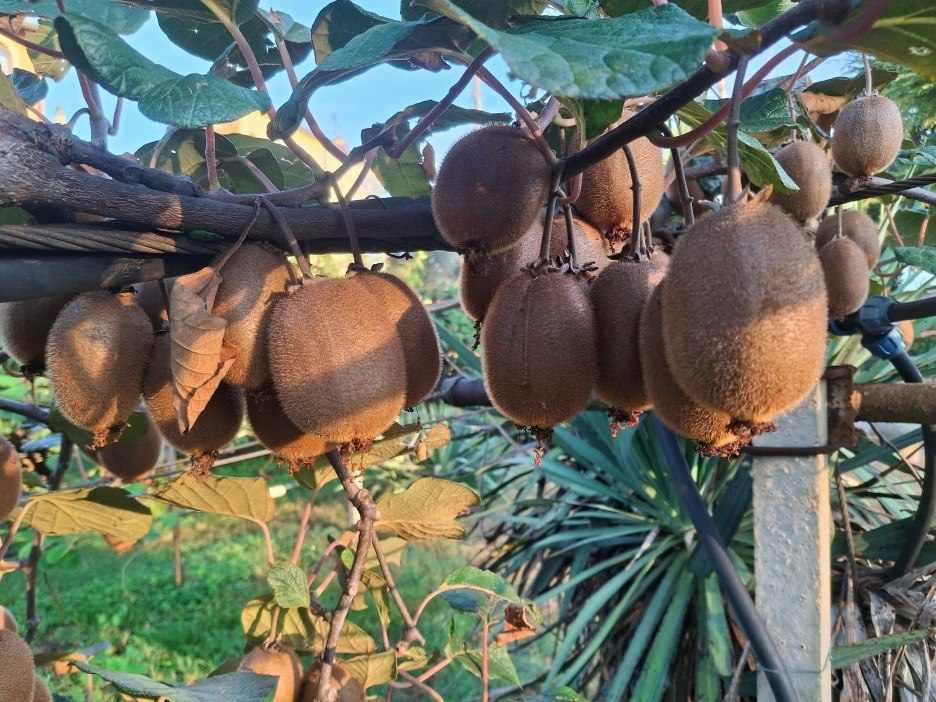
Four years ago, a group of kiwi farmers in the province of Verona, Italy, was losing plants to a mysterious decline that had puzzled growers and officials for years. The usual fixes (better drainage, adjusted irrigation, raised beds…) helped, but the dying continued. What was missing wasn’t a technique, rather a keen observation of the bigger picture. It was a way of seeing the soil itself, as the cornerstone of a whole unified ecosystem.
That’s where Giorgia came in. A soil consultant trained in the Soil Food Web method, she spends her days looking at soil the way a doctor looks at blood work: under a microscope, tracking the bacteria, fungi, protozoa and nematodes that determine whether a soil is thriving or collapsing. Her work with the Veronese kiwi growers became something bigger than a technical fix for root-knot nematodes, it became a case study in what it really takes to bring a soil back to life, and why that process is inseparable from rebuilding trust between people.
In this conversation, we talk about the hidden culprit behind the kiwi die-off, why organic matter is the non-negotiable foundation of any regeneration effort, how healthy soil becomes an ally against climate extremes, and how a homemade “tea brewer” machine turned into the seed of an entire farming community.
Giorgia, could you introduce yourself and tell us how you first got involved with this group of kiwi growers?
I’ve been working as a soil consultant for several years now, using the Soil Food Web approach: essentially, we look at soil biology under the microscope to understand which microorganisms are present, in what proportions, and how they’re functioning together. This particular case is interesting because it combines both a technical and a deeply social side of regeneration.
It started about four years ago in the province of Verona. I was contacted because of my familiarity with a specific group of microorganisms that the Soil Food Web method pays close attention to: nematodes. The growers were dealing with kiwi vine decline, a disease that had never officially been linked to root-knot nematodes. For years, that connection simply wasn’t part of the conversation.
What had been tried before you got involved, and what was it missing?
The interventions up to that point were mostly about water management: changing irrigation strategies, building raised beds to reduce waterlogging around the roots. These are genuinely good practices, I don’t want to suggest they were wrong. But they addressed only part of the picture.
When we finally looked at these soils under the microscope, we found large populations of root-knot nematodes, organisms that literally puncture plant roots, causing the characteristic “galls” you find on damaged kiwi roots. What was missing wasn’t just water control. It was the antagonists: the beneficial microorganisms and predator populations that should have been keeping those nematodes in check. Without a diverse, functioning microbial community around the roots, the plants had no natural defense.


How did you start turning that around?
We began with regular microscope monitoring, and then introduced compost tea, a liquid made by oxygenating compost so that its microorganisms multiply rapidly, creating what is essentially a living, microbial inoculant. It’s applied both to the soil, around the root zone, and as a foliar spray.
What makes compost tea different from a lab-produced microbial product is important: a commercial product usually contains a single isolated strain (e.g. one type of Trichoderma) grown in a lab, without any organic matter attached to it. Compost tea, on the other hand, is organic matter, the organic matter from the compost itself, extracted along with the whole community of organisms that live in it, all still actively feeding and reproducing together. We were also careful to select compost batches especially rich in beneficial, predatory nematodes, along with beneficial fungi; some, like Pochonia, actually act as natural predators of root-knot nematode eggs.
You often stress how much organic matter actually matters here. What are we talking about in real numbers?
This is the piece I really want people to understand, because it’s easy to say “just add organic matter” and much harder to actually do. To get any meaningful results from microbial treatments, you need a baseline of around 2 to 2.5% organic matter in the soil: below that, the inoculants simply don’t have anywhere to establish themselves. Ideally you want to be moving toward 3.5% or higher, but for most working farms today (not backyard gardens, real production agriculture) even reaching 2.5% is far from automatic. Most agricultural soils right now are dangerously low in organic matter.
The reason this threshold matters so much is simple: organic matter is literally the home of soil microorganisms. You can add all the beneficial microbes you want, but if there’s no organic matter to host and feed them, it’s like moving a population into a place with no houses. This is exactly what we saw in the field: the growers who already had somewhat richer soils, with more organic matter, showed faster and stronger colonization by the beneficial organisms we were introducing, we could see it directly under the microscope.
You’ve described this project as being as much about relationships as it is about microbiology. Can you unpack that?
Absolutely, and I think it’s the heart of the whole story. In a biocomplete compost, what matters isn’t just which individual species are present. What matters is the relationships between them, the way different microbial communities interact, compete, and support one another. That’s what determines whether you get a beneficial outcome or a harmful one.
And the same logic applied at the human level. This group of farmers was working within a very conventional agricultural context in Veneto, where individualism tends to dominate: everyone tends their own plot, and technical advisors are often seen mainly as people trying to sell products. Shifting that mindset was, in its own way, just as important as shifting the soil biology. Before we could really talk about organic matter or microbial inoculants, we needed a first year just building trust and understanding within the group. I call this “social regeneration”, and I don’t think it’s separate from soil regeneration. They’re the same process, playing out at different scales.
Was there a turning point where the group really came together?
Yes. And it came from one farmer in particular, Sergio, who was more receptive to the approach than the others. Rather than importing what’s called a “tea brewer” machine from the United States, he worked with me to design and build one himself, right on his own farm. From there, month after month, he began producing compost tea and distributing it to the other growers, who would come and collect it with their own containers.
Without him, coordinating a group like this simply wouldn’t have been possible. What started as one farmer’s willingness to experiment turned his farm into a genuine field research station, and it became a space where people met regularly, exchanged knowledge, and built something closer to a community than a supply chain. That informal, almost convivial side of it mattered as much as the science. It’s also worth mentioning our collaboration with Deafal, an NGO working in organic and regenerative agriculture that was already supporting these growers on the disease side. My colleague Elisa there was the one who first suggested we needed to properly profile the microbiology of these soils.


Beyond the individual orchards, what does a soil that is biologically rich and well-structured do for climate resilience?
This connects directly back to organic matter and soil structure. A soil with healthy organic matter content and a diverse, active microbial community absorbs water far more efficiently; we also saw this directly when compost was combined with the raised-bed drainage systems the growers were already using. Instead of water running off or pooling and suffocating the roots, a well-structured soil takes it in and holds it.
That capacity works both ways: it helps a soil buffer against drought by retaining moisture, and it reduces runoff and erosion during heavy rainfall. As temperatures rise and rainfall becomes more erratic, both of which contributed to the pressure these kiwi orchards were already under, that regulating capacity isn’t a side benefit. It’s central to whether an agricultural system can keep functioning at all.
Looking back, what do you think this story ultimately shows?
That soil health isn’t something you restore by simply applying a product. It’s something you rebuild by rebuilding relationships, between microorganisms, between farming practices and natural cycles, and between the people working the land. The organic matter is the material foundation; without enough of it, nothing else can take hold. But the relationships, both microbial and human, are the living fabric that actually makes regeneration possible and lasting.
What moves me most about this particular story is that nobody designed it top-down. It grew field by field, conversation by conversation, one batch of compost tea at a time. And it’s still growing today.

If you’d like to know more about the Soil Food Web approach or connect with Giorgia Liberati about her work with soil microbiology, you can read more on her website https://www.radiciconnesse.com/
LATEN WE HET WAARMAKEN!