
>
Save Soil Regenerative Revolution>
Blogs>
Human Impact Stories>
Cultivating a Banana Forest: A High-Yield, Resilient Natural Farming Method
Share
Cultivating a Banana Forest: A High-Yield, Resilient Natural Farming Method
Human Impact Stories

12 May 2026

06:51 am
Achieving 30-ton annual yields and climate resilience through an innovative, zero-waste agricultural system that mimics a rainforest.
The Resilience of the Banana Forest
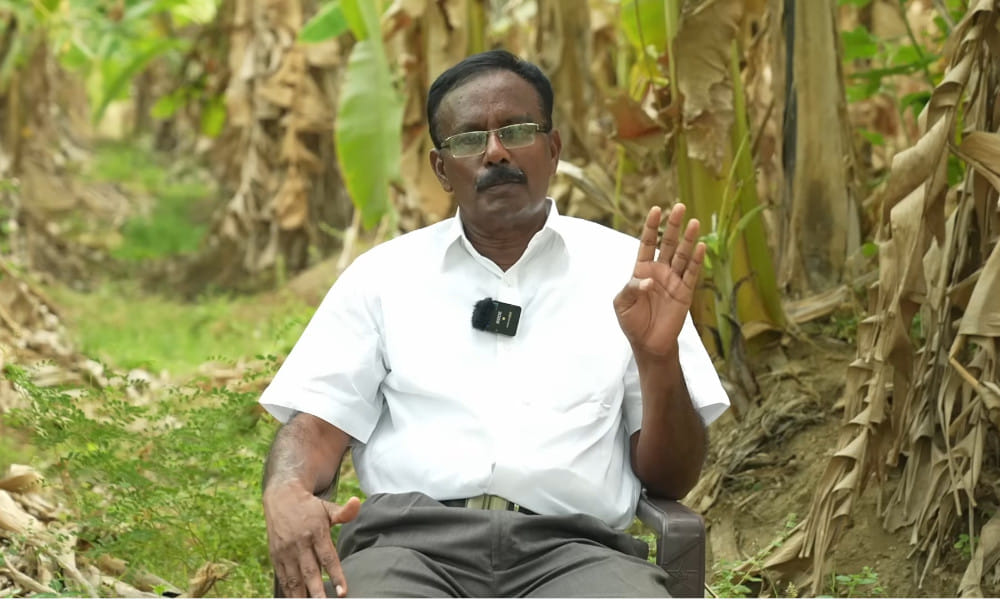
In this Banana Forest technology, not a single plant will fall. I say this firmly: a nearby palm tree might topple, but you cannot destabilize even one banana tree here. We consistently harvest 1,000 bunches every four months. Assuming an average of 10 kilograms per bunch, we can harvest 3,000 bunches a year from this system, totaling 30 tons. The trees do not fall during windy seasons, nor do they rot during rainy seasons. Because of this concept, there is never any destruction here, it only ends if we destroy it ourselves.
Creating Nutrient-Enriched Water
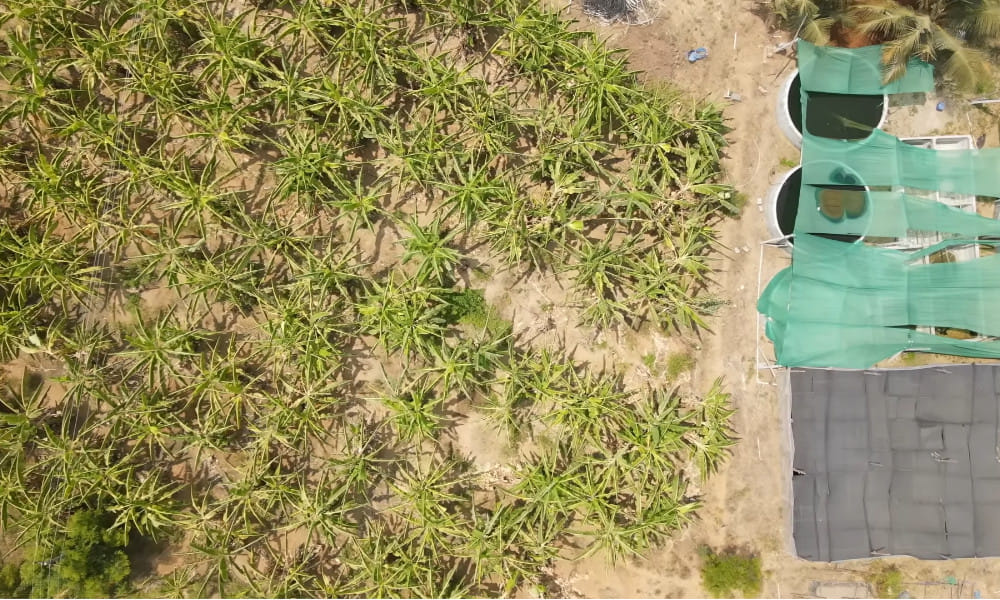
We achieve this stability and growth through a specific setup designed to create nutrient-enriched water. I have built a large tank, and above it, I have set up a loft where I keep ducks, chickens, and goats. Below that, I have released fish. The arrangement ensures that the waste from the ducks, chickens, and goats falls directly into the tank. The fish then consume this waste to grow. The fish excrete waste containing ammonia, which I convert into nitrate-essentially urea. This process creates the nutrient-enriched water that feeds the farm.
Constructing the Rainforest Equivalent
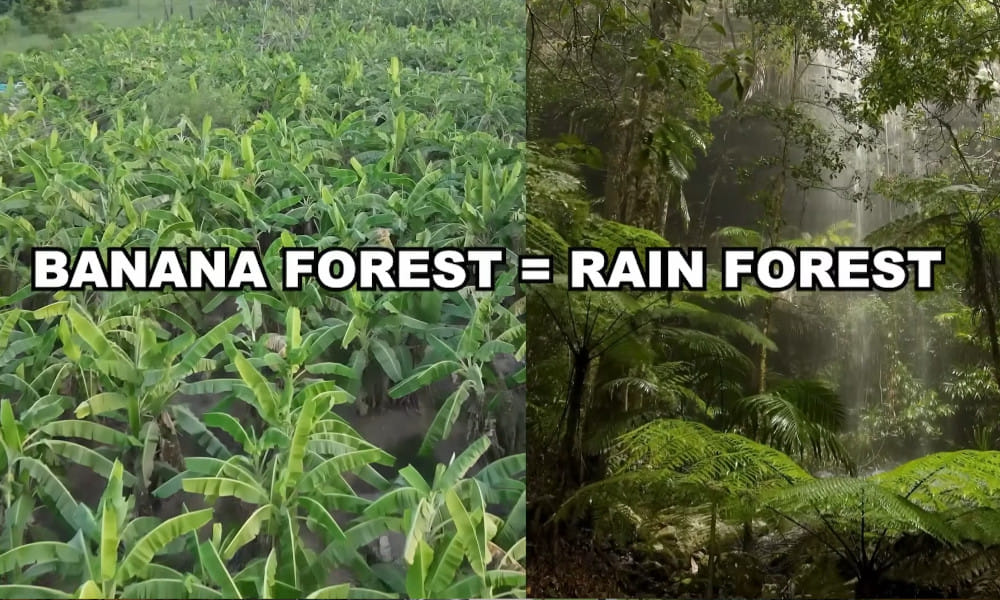
The raised bed used in this system is designed with an 8-foot diameter, a 2.5-foot height, and a 10-foot bottom diameter. The soil in these raised beds never hardens, it always remains loose and friable. We can set up this Banana Forest for 30,000 rupees. This system is equivalent to a rainforest, the same amount of oxygen produced in a rainforest is generated here. Among the world's food crops, the banana tree has the longest leaf, maximizing photosynthesis. While it takes 50 years to create a natural rainforest, this system becomes one in just a single year. Therefore, this technology is excellent for addressing global warming, allowing farmers to courageously cultivate bananas.
Farm Layout and Long-Term Maintenance
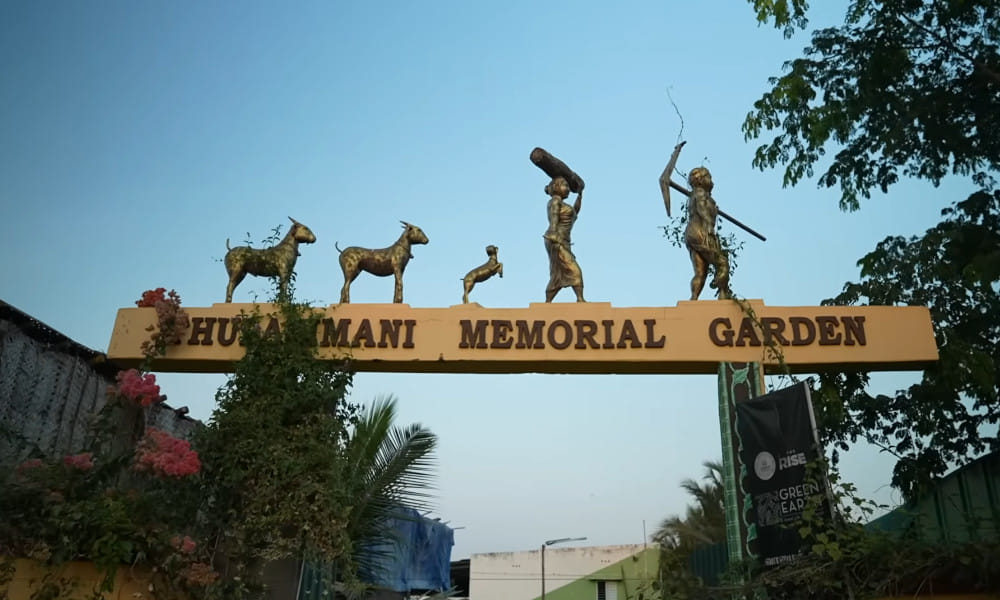
My farm, Duraisamy Memorial Garden, is located near the Vasantham Paradise residential area and spans 11 acres. I have been practicing natural farming for nearly 10 years. This Banana Forest involves cultivating bananas on raised beds, a first in India. Once planted, the system can be maintained for over 25 years. There is no need for ploughing or weeding inside the cultivated area. You can add as much manure as needed or sow nine-grain seeds and plough them in initially. Using a five-tyne cultivator four or five times makes the soil very loose. After that, a digging machine can be used to pile the soil into the specified dimensions. This layout results in 250 raised beds per acre. The distance from the center of one bed to the center of the next is 13 feet. A digging machine requires about 30 hours to complete this setup, so even at 1,000 rupees per hour, the total cost is approximately 30,000 rupees.
Efficient Irrigation and Nutrient Management
The 30-ton harvest is supported by the nutrient-enriched water we create. I do not provide plain water; I transform it into a nutrient-rich solution. Into the tank water containing fish waste, I add Panchagavya, Fish Amino Acid, and EM solution, providing full aeration to enrich it completely. This flows out daily. This nutrient-rich water is the main reason for the health of the bananas, and it works well for all crops. Once the circular beds are ready, we install a drip irrigation system with black lateral hoses positioned to release water into the center of the bed. From the center point, we plant four suckers 2.5 feet away, one in each direction. Irrigation in the Banana Forest is highly economical, the water required for flood irrigation on one acre can sustain three acres of Banana Forest. The ground inside remains dry, as only the beds are watered.
The Planting Cycle and Continuous Yield
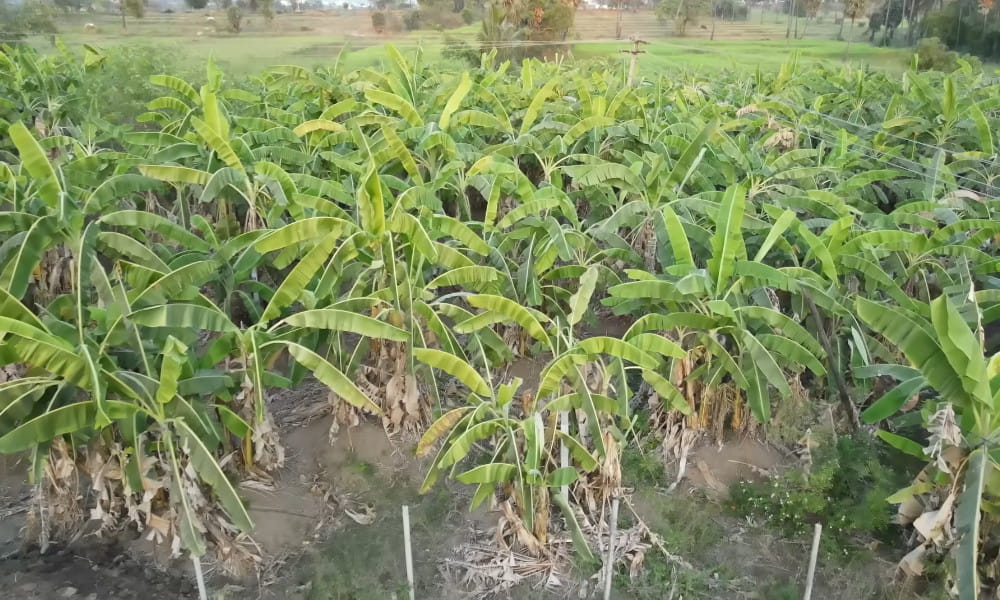
It is crucial to use only native varieties for this system, tissue culture or hybrid bananas are not suitable. For my first trial, I used Honey Banana (Thenn Vaalai), Rasthali, and Poovan. These can be mixed in a single bed or planted separately. After planting the four suckers, water released in the center spreads automatically, allowing the plants to grow.
Within six months, many side suckers will appear. At this stage, we select one good side sucker for each tree and cut the rest. The original four suckers will be nearing the flowering stage. We planted four, and now there are eight: four flowering and four growing as "babies." The flowering ones yield fruit, while the side suckers reach the flowering stage with a four-month gap between generations. Every four months, we allow a new side sucker to grow. The first yield arrives between the 10th and 12th month. From then on, we harvest 1,000 bunches every four months, totaling 3,000 bunches annually.
Environmental Impact and Structural Stability
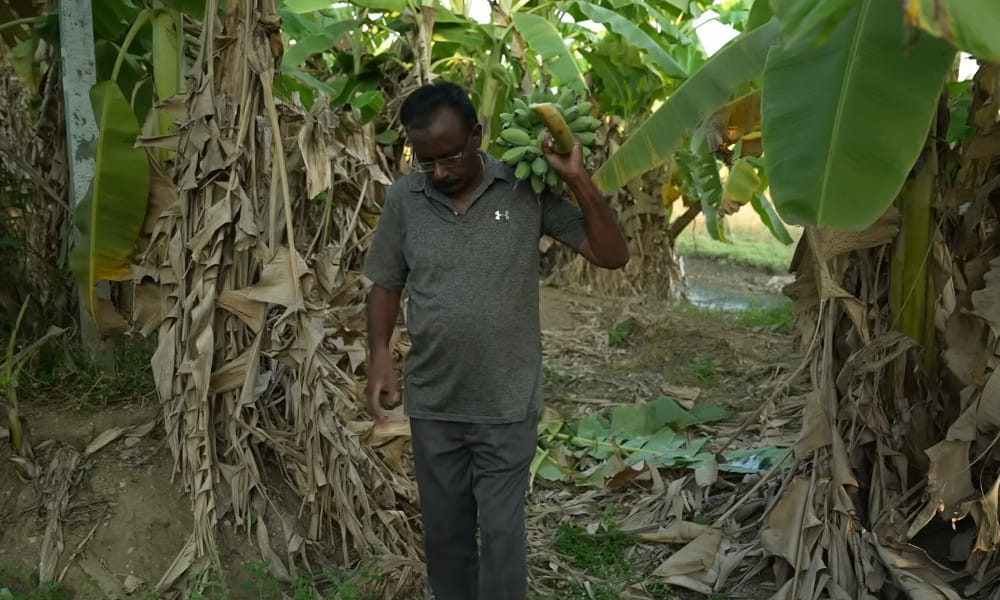
Around the ten-month mark, the trees in the raised beds touch each other, connecting the canopy from one bed to the next. This prevents maximum sunlight from hitting the ground, marking the true formation of the "Banana Forest." This dense canopy facilitates significant photosynthesis and oxygen production. While a standard rainforest prevents sunlight from hitting the ground, so does this system. If 100 acres of this are planted in a village, rainfall can increase by at least 10%.
In this technology, the trees grow as a group of 12 on each raised bed: four bearing bunches, four flowering, and four babies. Their roots interlock underground, providing immense stability. No matter how hard the wind blows, the trees will not fall.
Weather Resistance and Waste Management
We designed this system to withstand all four seasons. During the rainy season, water stagnation often causes bananas to rot. However, because the plants are on raised beds, they remain unaffected regardless of standing water at the bottom. The soil remains loose, allowing for easy root penetration and "air pruning," which promotes vigorous growth.
Unlike conventional farming, where harvested trees are cut and thrown out—creating pollution and waste, we use a different method based on Subhash Palekar’s natural farming principles. After harvesting the bunch, we leave the stem standing. The next side sucker absorbs all the nutrients from this stem to grow. Within three months, the old stem decomposes completely and falls as mulch. This natural decomposition happens quickly and fuels the next plant with about 50% of its required energy.
Yield, Quality, and Value Addition
This system is 100% natural farming. While natural farming might yield 100 fruits compared to 200 in Non-organic farming, the cost of labor in non-organic farming often consumes the value of the extra yield. Here, the yield is double that of conventional methods-30 tons compared to 15 tons. The taste of these native bananas is unmatched and holds medicinal properties, which keeps customers returning.
We only sell a portion of the harvest as raw bunches. The rest is converted into value-added products. We successfully make nearly 20 products, including baskets from sheaths, handbags from fiber, stem flour, raw banana flour, banana flower pickle, banana flower malt, and chips. This diversification ensures a significant profit.
Weed Control and Minimal Intervention
In the Banana Forest, there is no weeding work. For the first six months, weeds grow abundantly, often taller than the banana plants. However, once the canopy connects, the weeds are naturally controlled. Within a year, weeds disappear completely. There is no ploughing; the only task is watering. Human hands should not touch the plants unnecessarily-no peeling sheaths or cleaning inside. Once planted, the next step is the harvest. We cut the bunch, drop side leaves as mulch, and leave the stem.
Farmers can courageously cultivate bananas using this technology. By doing so, you provide healthy food to society and secure a healthy income for yourself. You gain financial health and the good reputation of feeding the community. I thank Isha for this opportunity.
Keep In Touch
Get the latest updates on blog and happenings at Save Soil Regenerative Revolution and on the rest of Isha's social work — delivered to your inbox.