
>
Save Soil Regenerative Revolution>
Blogs>
Human Impact Stories>
Transforming Agriculture Through Value Addition and Five-Layer Farming
Share
Transforming Agriculture Through Value Addition and Five-Layer Farming
Human Impact Stories

16 Jun 2026

07:12 am
How a natural farmer in Mettur maximizes profit by reducing waste, creating market-ready products, and adopting a zero-tillage multi-crop system.
Turning Waste into Wealth
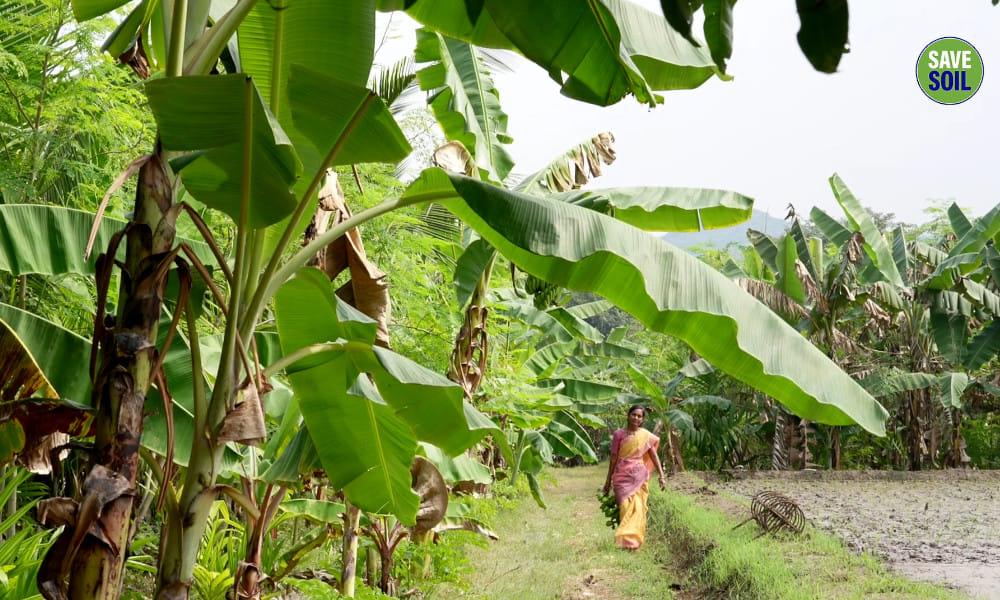
My name is Shyamala, and I practice natural farming in Mulakkadu village, located near Mettur in the Salem district. When observing our banana farming, we noticed a significant amount of wastage, particularly regarding the banana flower. Initially, we simply cut these flowers and discarded them on the ground. However, seeing this waste prompted me to ask myself why this resource was being thrown away and what could be done about it.
In our first year, we established a farm outlet shop, and by the second year, we opened a shop in Mettur town. While sitting at the shop and observing the daily activity, I noticed that in the evenings, people would flock to the chili fritter shops across the street. This observation sparked a simple idea to attract those customers to our own establishment: converting our discarded banana flowers into banana flower fritters. That is how we started.
From there, we expanded into making banana flower thokku and pickles. The pickle began as a homemade item prepared by my younger brother’s wife. The taste was superb, and when our customers tried it, they praised it highly, which led us to learn how to produce it commercially. At our shop, we also extract banana stem to serve juice and buttermilk. We offer milkshakes made from one or two fruits mixed with a spoon of country sugar and 50 milliliters of milk for thirty rupees. Value addition is simply a matter of small efforts and attention to detail. It is not about complex exports but about providing healthy food to the people around us.
Direct Marketing and Building Demand
By engaging in value addition, there is no need for our income to go elsewhere, it stays right here in our town. Our farm is located on the Madeswaran Malai route along the Mysore Highway, in an area with no immediate neighbors. Our customers are primarily travelers passing by. Whether they are locals or people traveling from out of town, once they purchase and taste our fruit, they often call us later from places like Chennai to request more. We now parcel fruit to Chennai and Bangalore via service couriers. The taste of the fruit drives this demand, and currently, we find ourselves unable to fully meet our customers' requirements. We utilize value addition strategies specifically when we have excess fruit production.
The Economics of Value Addition
A major challenge in natural farming is marketing the produce. Marketing does not necessarily require setting up a stall elsewhere, it begins with your immediate network of friends, relatives, and neighbors. We also utilize the opportunity when visitors come to our garden for training. For instance, a group of 100 people from Tiruvannamalai district visited us, and we used that time to create awareness about natural farming and value addition.
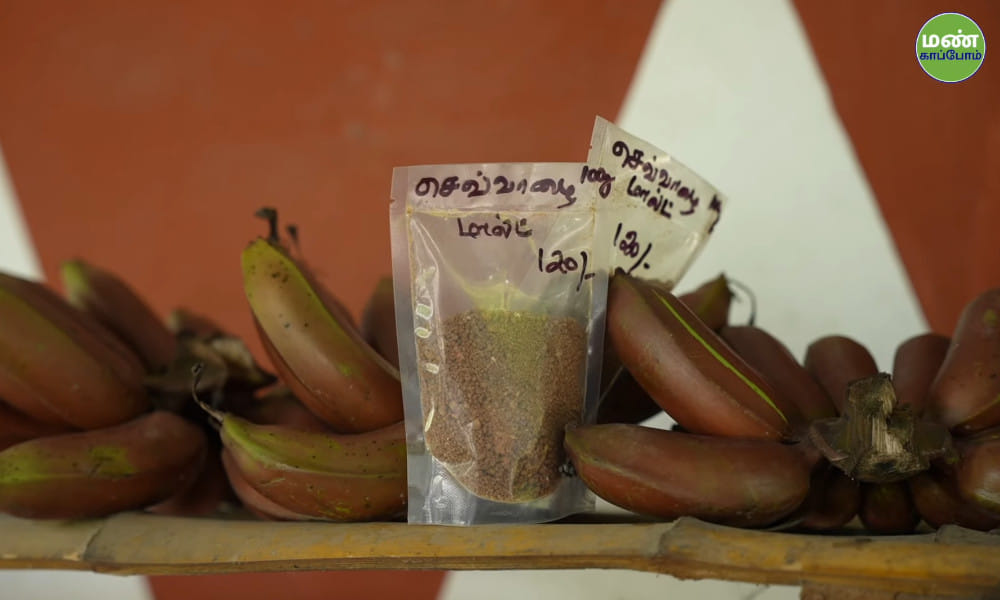
There is significant wealth in our gardens that often goes unrecognized. Even Bermuda grass can be made into juice, and Indian Nettle can be used to make soap. Previously, I leased my coconut trees for just five thousand rupees. Today, we extract one liter of coconut oil from those nuts, produce one kilo of soap, and sell it for 800 rupees. Similarly, raw Red Bananas sell for 10 or 12 rupees, but if processed into Red Banana Malt, 100 grams sells for 120 rupees. This translates to 2400 rupees for two kilos of powder. This is not a fabricated story but the reality of value addition. We produce these goods according to demand rather than mass-producing them blindly.
Strategic Production Planning
Farmers should assess the market before planning their production. I once planted turmeric on thirty cents of land, and it took over a year and a half to sell the harvest. Consequently, I decided to limit production to match my sales capacity. I prefer not to mass-produce and dump my goods into a saturated market. I have divided my garden into sections to produce only what I can sell through my own channels. This prevents the situation faced by farmers who plant large acreages of sugarcane or banana only to be forced to sell to factories at low rates, which degrades the soil and offers little profit.
A Shift in Lifestyle
We prioritize producing what we need for our own consumption, such as horse gram, sesame, and urad dal. Since adopting natural farming, my lifestyle has changed significantly, and my reliance on external goods has been minimized. Taking up natural farming is a beautiful process. For those currently practicing chemical farming, I urge you to switch to natural farming.
I do not grow bananas as a monocrop, they are an intercrop within a two-acre multi-crop system. This system includes turmeric, ginger, pepper, timber, Areca nut, and coconut. Farm design is critical, whether for 50 cents or five acres. Our garden is zoned for vegetables, short-term crops, annual crops, lifelong yielders, and a dense forest area. We also cultivate traditional paddy on one acre, processing the excess into rice after saving seeds.
The Business of Farming
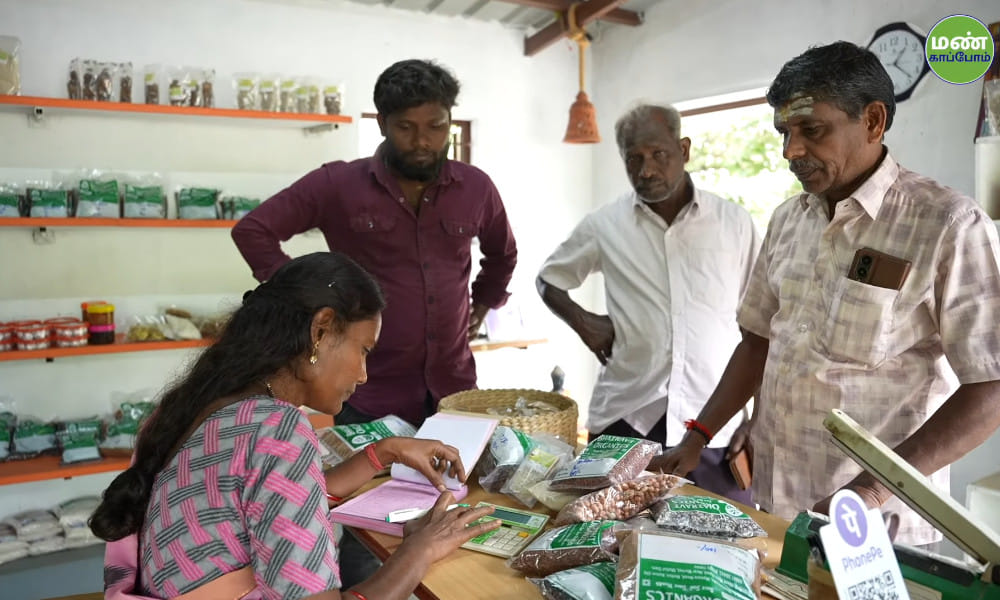
We must proudly proclaim the value of our work. If processed snacks with little nutritional value can be sold in remote village shops, we should certainly promote our healthy products. We must be the ones to articulate the greatness of what we produce. Nammalvar said that farming is only 20 percent of the success; the remaining 80 percent lies in converting that labor into trade. We must dedicate effort to business. While we must work in the garden, we can delegate tasks to allow time for sales. Failing to sell what you produce results in significant financial loss-far more than the cost of daily labor wages. We need to break the hesitation and barriers preventing farmers from becoming business people.
My goal is for a farmer to earn as much as a doctor or engineer. My husband has been fully supportive, leaving his own profession to work with me as a full-time farmer, despite skepticism from others. I am grateful to him, my Guru, and Isha's Save Soil Movement for this opportunity.
Implementing Five-Layer Farming
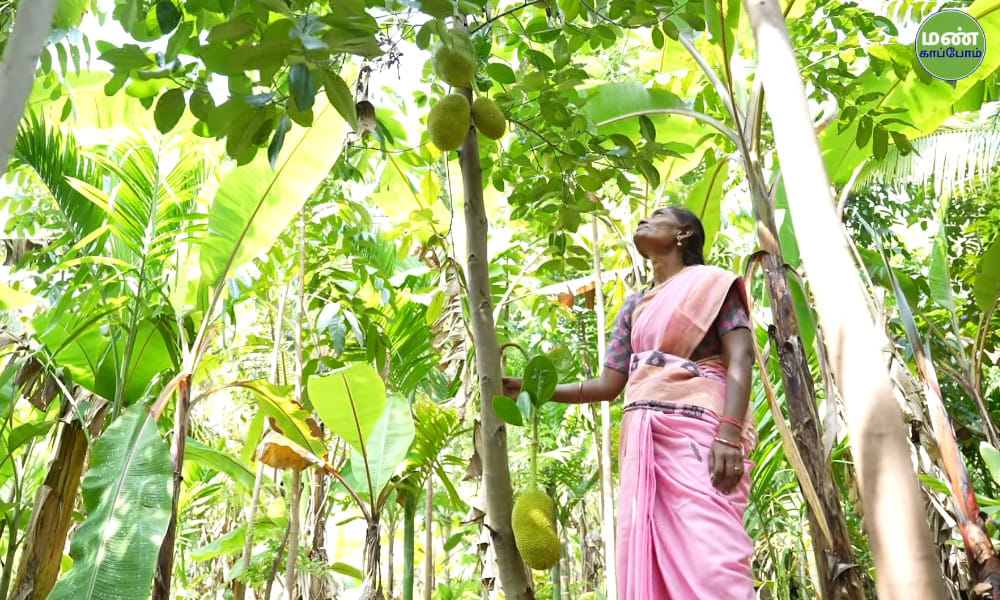
We practice Five-Layer Farming on one and a half acres. The layout involves a 36 by 36-foot spacing containing four coconut trees. Between these trees, we established nine beds. Each bed is three feet wide, separated by a one-and-a-half-foot trench.
The planting sequence along the beds is coconut, banana, and drumstick. We plant bananas and drumsticks alternately along the length of the bed. Next comes the Areca nut. We maintain a nine-foot gap between Areca nut trees. In the center of this gap, at four and a half feet, we plant pepper trained onto Gliricidia poles. We planted the Areca nut in the second year to ensure there was sufficient shade and to prevent stunting the coconut trees. In the 36-foot space between coconut trees, we have 69 plants. For the center plant, we use specific trees like Nutmeg, Jackfruit, or Jamun in different sections.
Soil Preparation and Irrigation Management
Before starting, we prepared the soil by sowing multi-grains, plowing, and using a rotavator. For the Five-Layer model, we practice zero-tillage farming. We do not weed or plow manually. We initially grew and harvested sorghum to use as mulch, covering the beds completely before planting. We then sowed intercrops like urad dal, cowpea, marigolds, and chilies.
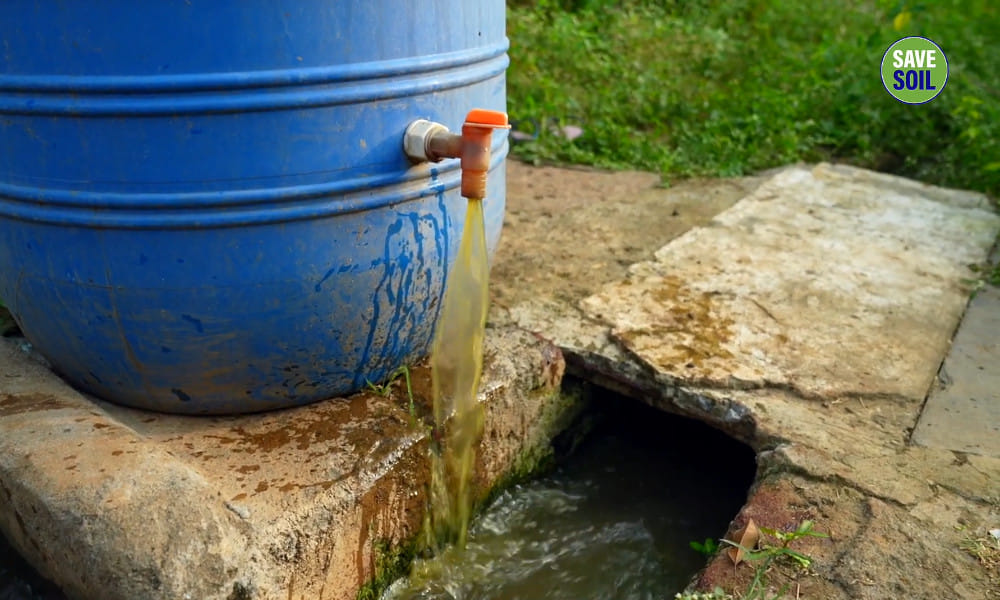
We do not use external organic manure for individual plants. We supply Jeevamirtham through irrigation water. Initially, we used drip irrigation, but as the trees grew and biomass increased, water distribution became uneven, and the dry leaves decomposed slowly. We switched to a rain hose system. The water spraying over the large volume of banana and drumstick waste accelerates decomposition, naturally creating compost and increasing earthworm activity. We generate approximately 28 tons of banana waste per acre, which becomes organic fertilizer in the trenches.
Economic Viability and Reduced Costs
Our income started with short-term crops like urad dal, flowers, and chilies. Later, we began harvesting bananas and papaya regularly. From one and a half acres, we now earn between two to two and a half lakh rupees annually. This method is highly profitable because it significantly reduces labor costs. Since it is a zero-tillage system, we save money on plowing, ridge making, and weeding. This Five-Layer Farming model is a viable and profitable option for everyone, regardless of the size of their land.
Keep In Touch
Get the latest updates on blog and happenings at Save Soil Regenerative Revolution and on the rest of Isha's social work — delivered to your inbox.