
>
Save Soil Regenerative Revolution>
Blogs>
Human Impact Stories>
A Journey into Zero-Budget Natural Farming: From Psychology to Profitable Agriculture
Share
A Journey into Zero-Budget Natural Farming: From Psychology to Profitable Agriculture
Human Impact Stories

03 Mar 2026

06:24 am
Krishnaveni details her transformation from conventional to 100% zero-budget farming, achieving a 30% higher yield and significant profits with diverse intercrops.

Embracing Natural Farming: An Inspired Beginning
In 2015, I attended an eight-day class workshop by Palekar Ayya, which was held in many places. During this training, I gained significant insights into how to approach farming effectively. My name is Krishnaveni, and I am from Coimbatore. I hold an M.Sc. in Psychology. While contemplating further studies for a Ph.D., I watched a video by Sadhguru where he delivered a speech encouraging people to "put your hands in the soil." This deeply impressed me, leading me to decide that I should set aside other ideas and pursue farming.

Initial Ventures in Sulur
With a renewed sense of purpose, I applied the knowledge gained from the eight-day training, which provided me with clear guidance on various aspects of farming. We decided to begin our farming journey in Sulur, where we own four acres of land. Our first project there was cultivating Karunganni cotton, a native variety. To facilitate this, we initially purchased native cows. From these cows, we prepared Jeevamrutham and all necessary pesticides using native cow urine, following precisely the model suggested by Palekar Ayya. This method proved effective, and the Karunganni cotton yielded well. This positive outcome further solidified my belief in natural farming.
Transition to Zero-Budget Farming in Mettupalayam
At that time, we also owned another agricultural land, approximately four and a half acres, in Mettupalayam. This land was being cultivated using chemical farming by tenants. We decided to discontinue chemical farming and transition to natural farming ourselves, moving to this location. Here, our commitment was to practice 100% zero-budget farming.
Banana Cultivation: The Triangular Model
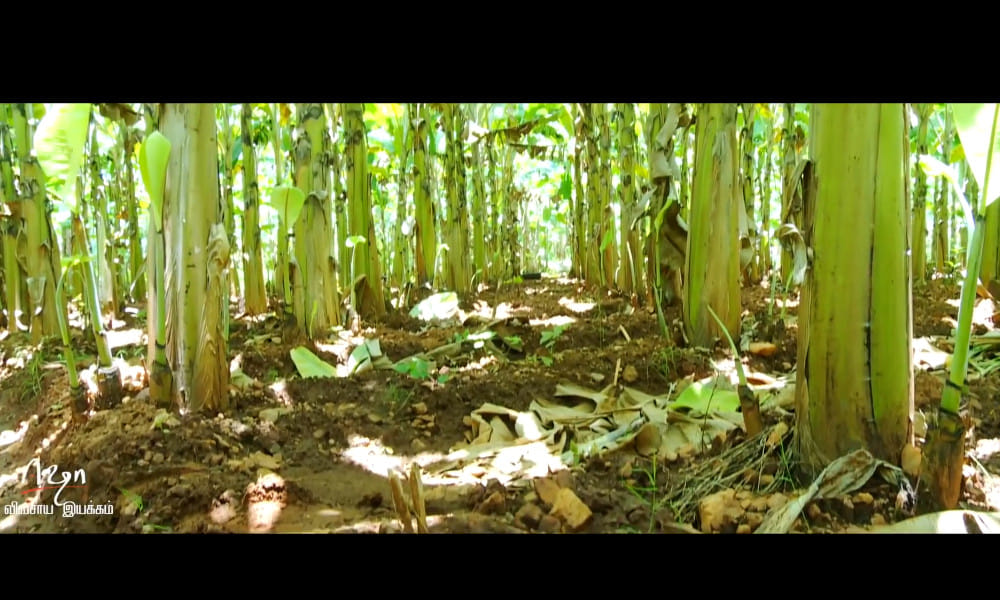
Currently, we have planted bananas. We adopted the triangular planting model that we had learned about in class. Across four and a half acres, specifically four acres and 80 cents, we have planted 5800 banana saplings. Of these, half are Nendran varieties and the other half are Kadali. For inputs, we primarily use Jeevamrutham and fish amino acids, which are applied both as foliar sprays and mixed with irrigation water.
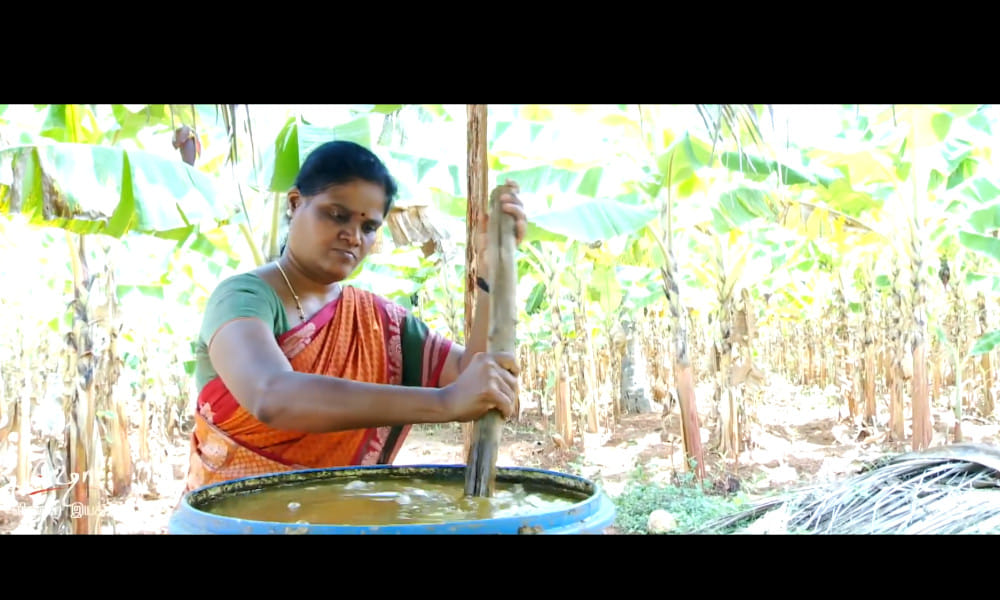
Shortly after we planted, representatives from the Isha Agricultural Movement came. They observed our methods and provided numerous corrections. We followed these diligently. They also informed us about an upcoming training session and encouraged our participation. I attended that training, gaining further insights that we subsequently implemented. We are consistently adhering to the natural farming method without deviation. We apply Jeevamrutham as a spray and mix it with irrigation water, and similarly, fish amino acid is applied as a spray and through irrigation. Additionally, we use a mixture of neem leaves and cow urine as a pesticide.
Economic Returns and Yield Enhancement
Through these practices, we achieved a significant yield. For the banana crop, we recently had our harvest last week. Our total investment in bananas so far has been 7 lakh rupees. During the last harvest, a single bunch of bananas sold for 325 rupees. Based on this, the total projected income from all our planted bunches amounts to approximately 18 lakh rupees. After deducting the 7 lakh rupees invested and accounting for other minor operational costs, we anticipate a profit of at least 9 lakh rupees.
The triangular planting model, in which we place the saplings, allows the land to remain open for about three months initially. During this period, there is ample sunlight and good water availability. Recognizing this, we decided to plant numerous intercrops, meticulously following the model. We cultivated chrysanthemums, green chilies, cowpeas, black gram, corn, and pigeon peas as intercrops. In the irrigation channels, we planted onions, which also provided us with an income. The cowpeas and black gram yielded well; we utilized half of the black gram for preparing Jeevamrutham and sold the other half. The chrysanthemums attracted a significant number of bees, which contributed to a good harvest through pollination. We also obtained a yield from the green chilies. Within those initial three months, all these intercrops provided a yield. Following their harvest, we tilled all the plant matter-including the leaves of cowpea and black gram-back into the soil. This rich organic matter decomposed, significantly enriching the soil and providing excellent fertilizer for the growing bananas. After removing all the intercrops, we fully shifted our focus to the banana plants. We then began providing ample water, combined with the decomposed organic matter, including the rotted leaves of the cowpea and black gram, which further nourished the bananas, leading to their robust growth.
Optimized Banana Spacing for Increased Yield
While the standard practice is to plant bananas six feet apart in straight rows, we use a triangular layout to maximize our space. Instead of planting in a straight line, we stagger the plants. We move four feet forward but shift the next plant three feet inward. This clever positioning creates a triangle, ensuring that every plant remains exactly six feet away from its neighbors in every direction-whether you measure straight, diagonally, or across. By switching to this triangular model, we are able to fit 30% more trees into the same field. Best of all, even with more plants in the ground, the quality remains excellent; each tree consistently produces the same heavy yield as those grown in traditional rows.
A Farmer's Perspective on Soil Health
A neighboring farmer, who cultivates nearby paddy fields, shared his perspective after observing the results of our natural farming. He admitted that because he uses "salt"-his term for chemical fertilizers-his expenses are double or even triple compared to our low-cost approach. He noted a remarkable difference in the quality of the land itself. In our natural farm, the presence of earthworms makes the earth incredibly loose and porous, when you dig into the soil, it feels very airy. In contrast, the neighbor observed that in his own fields, the use of "salt" makes the soil increasingly hard and compacted, causing the earth to lose its natural structure and sink downwards. This comparison clearly demonstrates how natural farming allows the soil to breathe and thrive.
Keep In Touch
Get the latest updates on blog and happenings at Save Soil Regenerative Revolution and on the rest of Isha's social work — delivered to your inbox.