



Interview with Yusuf Khan - Sustainability Reporter at the Wall Street Journal
Apr 27, 2026
Intro
Yusuf Khan is a sustainability reporter at the Wall Street Journal, covering agriculture, and how companies are navigating the energy transition - from climate tech and carbon markets to shifting regulations. Before moving to the sustainability beat, Yusuf covered commodity markets, where he saw first-hand how climate change was reshaping harvests and supply chains.
In this conversation, Yusuf talks openly about the realities of climate journalism - from the corridors of COP to a mountainside farming community in Portugal facing expropriation for a lithium mine, to the sound of monkeys returning to a reforested patch of Panama. His perspective really resonated with us - that the most powerful way to talk about climate and soil is through the people and places most affected by the crisis.
Hey Yusuf! Thank you so much for doing this interview. We thought to start with asking about how you got into covering climate change and the climate crisis?
I came from covering commodity markets - coffee, grains - and increasingly those stories were being shaped by climate change. Bad harvests, shifting weather patterns, the impact on crops. It was impossible to cover commodities without running into the climate story. Then a job came up on the sustainability beat and it went from there. Since then I’ve been going to COPs, attending Climate Weeks and really covering how companies are approaching sustainability - or not. It’s been quite a different experience compared to a corporate reporting background, but it’s something I’ve always been passionate about, so it’s worked out.
What inspired you to become a journalist in the first place?
I’d like to say I always wanted to be a journalist, but it wasn’t that romantic. I went to university not really sure what I wanted to do. I did a week in accounting and knew immediately it wasn’t for me! My roommate wrote for a student publication, so I asked if I could tag along. They gave me a story to write and I just got the bug. Talking to people, going out and reporting - even on small student stories, I fell in love with it. The writing, the storytelling, learning about people’s lives. It all grew from there.
You’ve been to COP climate conferences. What’s your experience of being there as a journalist?
My first COP was in Baku and it was quite overwhelming. There are people from literally every country in the world. I remember walking down a corridor and seeing FIFA President Gianni Infantino, then turning a corner and the Taliban were there. It’s a real melting pot - not a normal place you’d end up.
The thing about COP is that everyone inside is focused on the same thing. You see diplomacy in real time, protests, some of the best climate minds coming together. Everyone’s running around, hot and sweaty, laser-focused. But as soon as you leave that environment, you’re back in the real world - and most people aren’t talking about it. The challenge is translating the language of NDCs and climate targets into something meaningful for people making everyday decisions in their own lives.


Image: Yusuf at COP29 in Baku
Is it difficult to translate that technical language for an everyday reader of the Wall Street Journal?
It is, but that’s the same for any complex topic. At Wall Street Journal, we deal with nuclear fusion, bond markets, private equity - all incredibly technical subjects. Your job is to translate that for an ordinary person. We think about, say, a man or woman in Milwaukee or Cincinnati who might be picking up the paper. That’s who you’re writing for.
COP language can be very narrow, but you also get to talk to the best people in the field, and they’re usually very good at explaining things. When you get five minutes with them, they make my job a lot easier.
Making these topics relevant for the ‘person on the street’ is such essential work. That’s actually part of the idea of this publication too - to tell the stories of those working in the climate space who you might not usually hear from! Along the same lines, misinformation is of course a challenge for writing about stories in the climate space. How do you navigate this and are there ever tough decisions about what to share with your audience?
Nothing in this space is black and white, and you have to go in with that mindset. What’s true for one person isn’t necessarily true for another. Take emissions reporting - you have highly credible academics with completely divergent opinions on how companies should report their emissions. They’re all experts, and discerning what’s correct is genuinely tricky. A lot of it is grey, and your job is to present it clearly so that people can draw their own conclusions.
Makes sense. If there are situations where governments and local communities are telling different stories, how do you approach that as a reporter?
I try to lay everything out and let people consider their own conclusions. The way we’re taught is: you’re not the story. You want to write with a point, but not with an opinion. Be objective, take everything into account, and then cut through it - which is hard.
I did a story a couple of years ago about a lithium mine in Portugal. Lithium is incredibly important for the energy transition - it’s essential for batteries. But the mine was going to be built right next to a rural farming community in the mountains. You could literally see where it was going to be from their houses. The noise, the pollution - of course they didn’t want it. They’d been doing their thing in that environment for generations.
Then I went down to Lisbon and spoke to the politicians, and they said Portugal needs a mining economy, needs to be self-sufficient for its minerals, and can’t rely on foreign sources. They even said they’d be willing to expropriate the land. That’s a story where no answer is clean. You can see the economic argument, you can see how it enables the energy transition. But then there’s the real impact on real people. And that tension is something you see all over the world when you’re covering the energy transition.


Image: Near the location in Portugal where the prospective mine would be built
Like the one you’ve just shared there, covering the climate crisis can involve some very difficult human stories. How do you manage that personally?
A lot of what you deal with can be really depressing. I spoke recently to a woman called Trixy from the Philippines. She was suing a major oil company, along with around a hundred other Filipinos, for the impact of their pollution - arguing it had worsened the effects of climate change, leading to more serious typhoons that destroyed her home and killed many people. That was a tough conversation. She was crying, replaying what had happened. As a journalist, you need to keep going and get the full story, but none of it is easy to hear. She’d lost family members, her belongings, her boat - which she’d saved for years to buy. They relied on fishing for their livelihood. It’s very hard to hear how climate change affects people’s real lives.
Are there stories or innovations that have given you hope?
Yeah for sure! At the same time as the challenging stories, you get to report on really cool innovations and people doing incredible work. As much as I enjoy talking to the technical carbon removal people, I love speaking to the reforestation community.
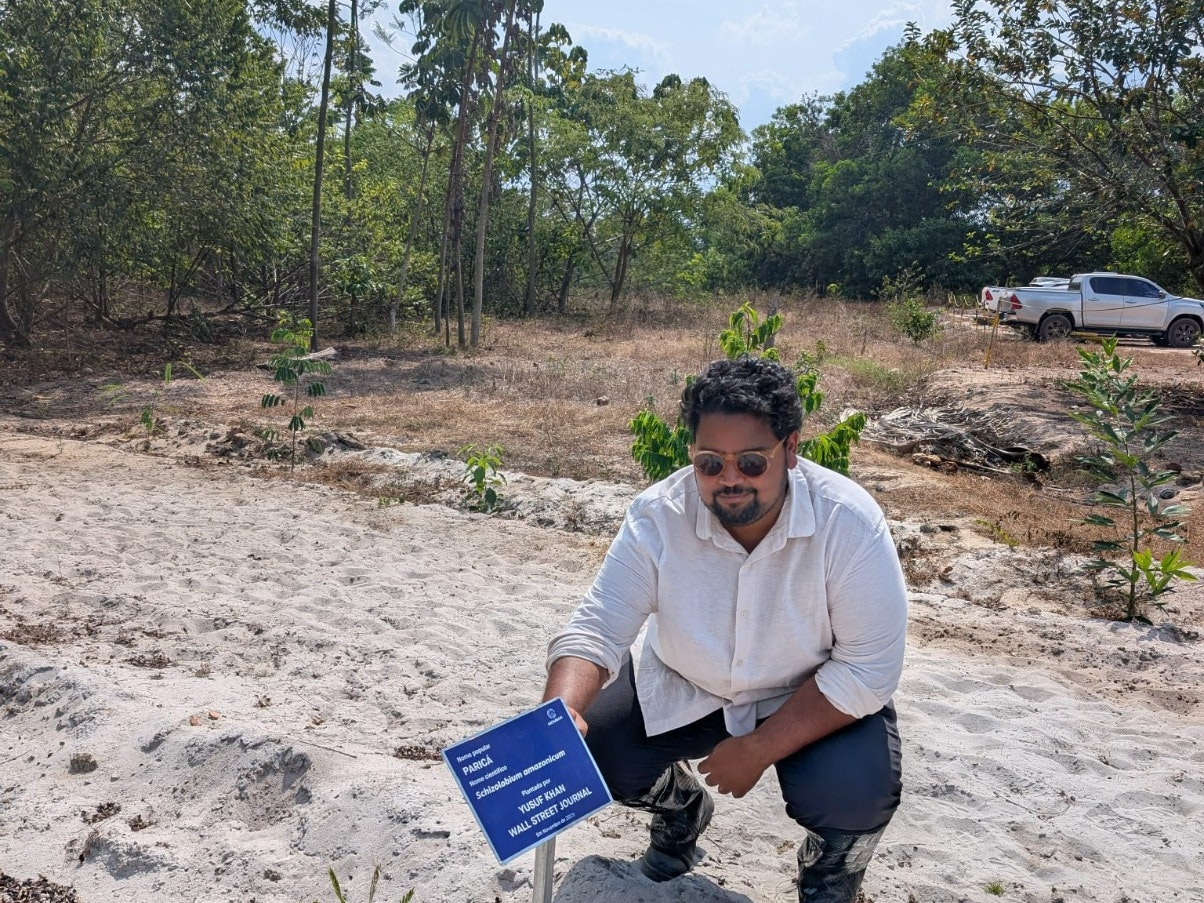
I spoke to Celia Francis, who runs a reforestation project in Panama. She used to work in tech and was inspired to start the project because her daughter was deeply concerned about climate change. She told me about how they worked with former cattle farmers, convincing them to become reforesters. And she described hearing the monkey sounds and the sounds of nature coming back. As much as direct air capture and other technologies are promising, there’s something powerful about actually rebuilding rainforest and seeing nature respond.
Incredible! The choices of stories must also be so vast, positive or negative. How do you decide which stories to pursue at the Wall Street Journal?
We have story targets and goals, but you also need to know your audience. Writing for the Journal means there’s a high bar - stories need to be quite original. You can’t just work off a press release; there needs to be more to it. Especially in the age of AI, your value as a journalist is finding new information. So I’m always thinking: what new angle can I bring? What would people not be able to get elsewhere?
You mentioned AI - we’ve heard from other journalists how this can be both a challenge and support to the profession. How has AI affected your reporting?
It’s two things. First, it’s a topic to write about in itself - the energy usage, the land and water consumption of data centres. There are going to be a lot of stories in that space. Second, as a tool, it’s really useful at the start of a story for finding sources and getting a sense of direction. Some reporters are using AI to develop models, code and analyse data sets to uncover broader patterns, which I think is a great use of it.
A good example is my colleague Ben Katz, who writes about aviation. He and his team used AI to analyse millions of reports about toxic fume events on aircraft - connecting incidents to people getting seriously ill. They even did a follow-up story about how they did the story. It’s a great illustration of using AI as a tool to support your reporting, but not as a replacement. You still need great sourcing, on-the-ground reporting and the human side of the story.
What has your experience been of writing about regenerative agriculture?
Regenerative agriculture is one of those tricky topics to write about, because the term is quite woolly - it doesn’t have a strict definition, and a lot of things get bundled under it. That can make it hard to pin down for readers who like specifics. But that doesn’t mean you shouldn’t be writing about it; it’s more about finding the right way in.
I wrote a story about a carbon credit programme in Texas where ranchers were rotating their cattle very frequently - sometimes daily - to help regenerate the soil. That locks carbon into the ground and generates carbon credits. For me, that was a great way to tell a story about regenerative agriculture and the importance of soil through the lens of ranching, which is a topic that really resonates in the US.
When you’re inside the climate world and talking to climate people, everyone uses climate terms as shorthand. One of the key roles of a journalist is to translate that jargon for readers. It’s basically what you’re told from day one of journalism school: make it clearer, cut the jargon. You have to train yourself, when you’re interviewing someone, to say: explain this to me in plain language. What does that actually mean? How does it affect people? I think it’s probably a challenge in every industry, but it can creep in very easily in the climate space.
Yusuf - thank you so much. It’s a privilege for us to speak with you, and such an insight for our audience as to what being a climate journalist is like.
If there was one positive message you’d like to leave our audience with, what would it be?
There are lots and lots of really good people in every part of the world doing really good things. My biggest takeaway from covering sustainability is that people often let the perfect be the enemy of the good. Progress gets criticised for not being perfect - for not meeting the highest level of scientific ambition. But doing something is still better than doing nothing. It may not be perfect, but as long as we’re taking a step forward, I’ll take that.
चला, हे घडवून आणूया!