



The Soil Carbon Sponge: Restoring Earth's Hydrological Cooling System for Climate Stability
Apr 22, 2026
by Dhami, A. S.; Yu, L.; Rau, R. and Sridhar, P.
We extend our sincere gratitude to the team at Regenerate Earth for their invaluable guidance and steadfast support throughout the development of this report. In particular, we would like to thank Walter Jehne, whose pioneering work formed the foundation of this study.
Executive Summary
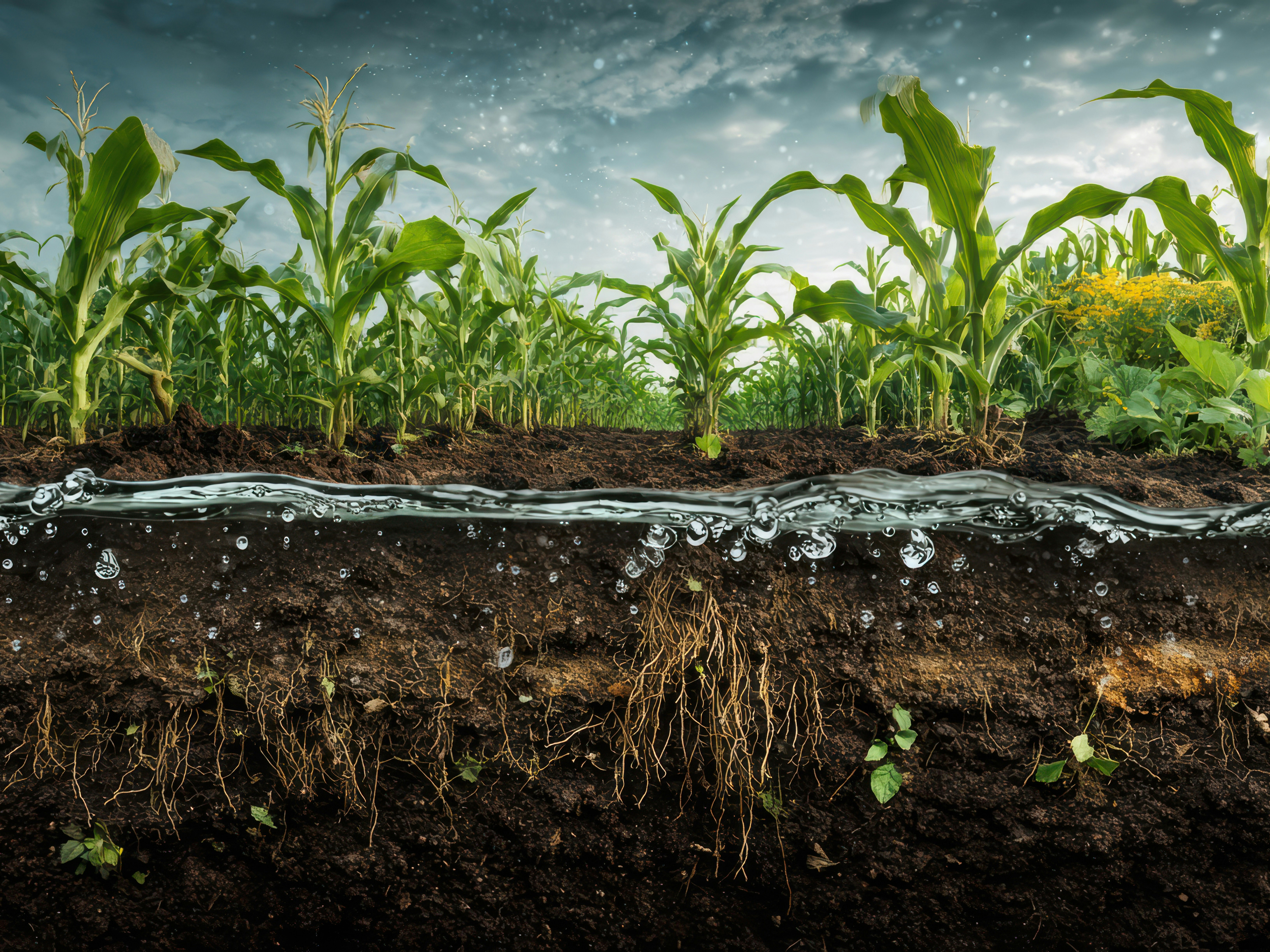
While contemporary climate mitigation discourse focuses primarily on carbon sequestration and the reduction of greenhouse gas emissions, this report introduces a critical additional strategy for climate stability: the restoration of Earth’s hydrological cooling system. For over 4 billion years, water has been responsible for approximately 95% of Earth’s heat dynamics through interlinked processes like evapotranspiration and condensation. Central to this system is the soil carbon sponge, a living, porous infrastructure of healthy soil that manages freshwater and enables the cooling processes essential for ecosystem function.
Currently, the planet faces a severe destabilization of this water cycle, with 52% of agricultural land degraded globally and nearly one-third of U.S. soils experiencing erosion rates up to 10 times higher than natural formation. This degradation shifts the surface energy balance away from cooling latent heat flux, which consumes heat through evaporation, and toward sensible heat flux, which directly increases air temperature. In Europe alone, 60-70% of soils are considered unhealthy , contributing to intensified heatwaves and a loss of the "green water" moisture that fuels regional cooling.
The report emphasizes that rebuilding the soil carbon sponge acts as a powerful climate regulator, as every 1% increase in soil organic matter allows a hectare of land to hold an additional 250,000 liters of water. This stored water sustains the vegetation necessary for continuous evapotranspiration, which exports roughly 80 W/m² of solar energy back into the atmosphere. Restoring this biological cooling force could potentially offset the 0.9 W/m² total energy imbalance causing global warming by re-establishing a cooling effect that is three times larger than the warming caused by human-induced greenhouse gases.
To achieve long-term stability, climate policy must prioritize the regeneration of soil structure across all land types to restore infiltration and water storage. Recommendations include minimizing bare soil exposure through cover cropping and mulching to suppress infrared re-radiation , and protecting forest ecosystems that drive "small water cycles" to return moisture to the soil. By integrating land regeneration with emissions reductions, we can restore the roughly 3.0 W/m² of lost natural cooling and enable landscapes to function once again as self-regulating climate stabilizers.
The full report can be viewed and downloaded here.

మనం ఇది సాకారం చేద్దాం!