



Interview with Oli Inglis - The Regeneration Mindset
Jul 4, 2026
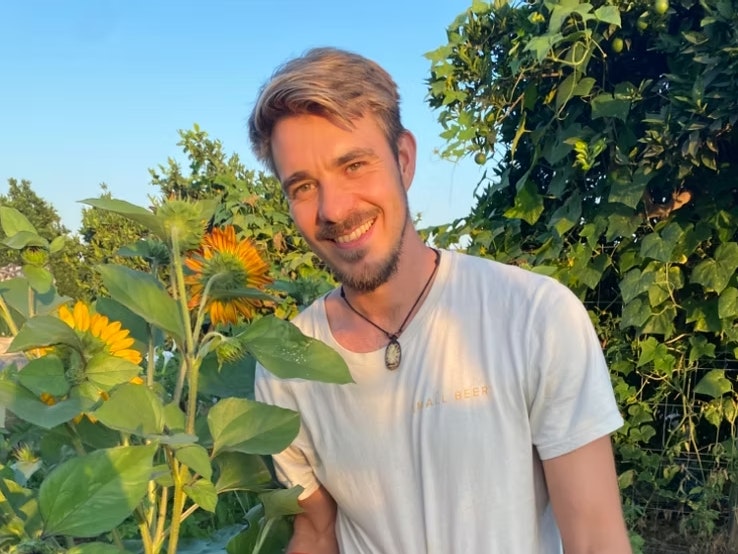
What began as a desire to reconnect with nature eventually led Oli Inglis, the creator behind Project Permacultura, into the world of regenerative agriculture, soil restoration, and climate-resilient landscapes. Raised between Northern Italy and the UK, Oli’s journey stemmed from gardening and allotments during lockdown, evolving into a deep exploration of soil biology, syntropic agroforestry, and various other practices - all rooted in the belief that we must learn to work with nature, rather than against it.
In this conversation with Conscious Planet, Oli breaks down the soil crisis in accessible, human terms, explaining why healthy soil functions much like the human microbiome: alive, interconnected, and essential for resilience. We explore the difference between sustainability and regeneration, the role of trees and microbial life in restoring degraded landscapes, and why regenerative agriculture may be one of the most powerful climate solutions we have. From food systems and farmer livelihoods to raising children in a soil-to-table environment, Oli reflects on what it means to rebuild our relationship with the land, and why restoring soil health is ultimately about restoring life itself. 🌱
Growing up on a farm in Northern Italy must have really shaped your connection with the land from a young age. Was there a specific moment or experience that comes to mind that shifted your thinking toward regenerative systems and practices?
A very clear moment, actually, and not what you’d expect. I grew up in Italy until about sixteen or seventeen, then moved back to the UK for university, then lived in London for a really long time. There I had this growing feeling that ‘I need to be in contact with land’, and be able to just have that creative freedom. Looking back now, I wasn't aware of that in the moment - I just knew I needed to do something. What I really enjoyed doing was spending time tending a garden or gardening, planting… so I got into landscape gardening, and through that, managed to get into an allotment association. You know when you find something, and any free moment you’ve got, you just want to do that? That’s what that was for me. Coupling that with covid, being trapped in a flat (and we already had a little bit of a ‘prep-er’ mentality), we wanted to have control over how we produce the food we eat. So it was actually quite far removed from my upbringing, although that helped me to learn the practical skills that I needed.
Most of our readers don’t necessarily have a scientific understanding of what’s going on under the surface… How would you explain the soil crisis in simple terms, and can you walk us through the core principles of regenerative agriculture - what makes it regenerative, rather than just sustainable?
Of course - both really good questions, by the way. I would say the easiest way to understand it is comparing it to human health. For example, in recent years, everyone's become more and more conscious of the gut microbiome, and needing a living population of flora in your gut and things like that. The more we enhance that with all types of beneficial bacteria that we need as humans in our body, the better we can absorb nutrients, the better resilience we have to illnesses. It's exactly the same thing with soil health. If you have barren, sterile soil, then you have no immune system. You have no resilience. You have no agents that are going to be decomposing - in this case, organic matter as food for plants, as opposed to what is food for humans.
This is a complete broad spectrum example - if you've got a sterile soil, which is often the case, from years and years of incessantly turning over the soil, and also spraying it with chemicals, not allowing any ground cover, and many of these incredibly unsustainable practices... It's almost like if you cut yourself and you put a bandage on it, and then you cut that same cut again, and keep doing it over and over and over and over. It's never, ever going to heal, right? But as soon as you properly heal it, cover it, look after it, and you make sure it's not exposed to the sun or negative bacteria, that's when it starts to heal, and it will get better.
Soil and any kind of natural system is incredibly resilient. but when it has incessant stress, like it would with a cut in our skin, there's only so many times it can recover. Now it’s at a breaking point. When we give it that little nudge in the right direction, it's very, very grateful, and it recovers very quickly. But if we continue down the path we're going, there's a point where we will have no more topsoil and no way to continue regenerating it – we're just left with bare rock, which takes thousands, if not hundreds of thousands of years to break down and turn back into soil.
As for the second question… the simplest and most accurate explanation, I would say, is regenerative is when you take your soil or your land, and by the time you leave it, you've left it better than the way you found it. That's regenerating, whereas sustainability is just sustaining the way it is already. There's a plot of land which is completely barren right in front of me, and I could just take that and do sustainable practices, but essentially, all I'm doing is sustaining dead soil. Whereas, if I regenerate it, then I have to leave it better, even if that's just a tiny little bit better than the way I found it.
Sustainability is another massively greenwashed, wasted term, because you can say anything is sustainable. I mean, of course! We're sustaining the slow and steady downfall of agriculture, but if we want to actually be able to survive in a changing climate then we've got to actually make it better every single time we interfere.
Wow, that makes a lot of sense. I guess sustainability is staying in the same dimension of change, but then it’s like going into 4D to actually accelerate or decelerate the process.
Yeah, that’s a cool way of thinking about it. It is kind of like, ‘sustainable’ is 2D and ‘regenerative’ is 4D. As in, we're going from linear, basic, to extrapolating to bigger images, like forest images and stratification.


For sure. You've also spoken about working with nature, not against it, and I was curious, how does that actually manifest in your daily work? What does that actually look like in practice?
Not picking a fight constantly is one thing – analyzing and studying before acting. With conventional farming we act as if everything is the enemy, and we're the smart ones. We know what's what, and we play God. We've got to constantly be looking out for what's trying to trip us up along the way.
What I do is more about prioritizing covering the soil. My day to day is more about walking around and thinking about smart ways of acting that enhance all of the different relationships between the components of a system. When you get your head around it, it's much more relaxing, because everything's actually working in our favour. It's trying to do things that we would otherwise be doing. It's a massive mentality shift.
A lot of people aren’t aware of the massive impact that soil health has on people and the planet - and its potential as a climate solution. For someone who’s not aware, what role does organic matter and microbial life play in the quality of the soil, and therefore in regenerating degraded land?
I would first quickly define organic matter in terms of carbon - which is basically part of every kind of physical material on the planet, but is especially present in organic matter, like leaves, branches, trunks of wood, things that derive from plants. When we burn it, we turn that carbon from solid form into a gas, which is what lingers in our atmosphere and contributes to global warming. If we then take that carbon in its solid form, don't turn it into this gas and we fix it back into the soil, then the soil decomposes that organic matter and turns that into nutrients and into soil structure, which has many advantages: it slows down erosion; it creates a spongy soil (so it maintains moisture and nutrients); and creates a habitat for beneficial bacteria and fungi. If we add nutrients or water, it's held in by all these little, tiny, spongy fibers, which are the carbon in the soil. Then as that carbon is decomposed by the microorganisms, like bacteria and fungi, they transform it into food for plants. And then, the plants recycle it back into that whole process by expelling oxygen and fixing that carbon back into the soil. So it's an endless loop. That's the magic of plants.
Ah, the carbon cycle, what a great explanation. And how does this take shape at a larger scale, where regenerative practices help build resilience for landscapes affected by climate change?
That’s a difficult one, because there are lots of techniques that we can use. My personal opinion is that trees are like the grandfather of the cycle. They provide the shade, they provide the organic matter. They sequester the carbon. They create these crazy roots systems in the ground that then infiltrate water and nutrients and all that stuff. So if you don't use trees on a massive scale in terms of regeneration, you're just missing a trick – you're making it really hard for yourself.
One of the techniques is syntropic agroforestry, which is this system behind where I’m standing right now. In brief terms, we're creating plants that contribute organic matter back into its own system. Whatever you prune from it goes back to the ground, decomposes, and then feeds the system itself. This is even being done on massive scales; in South America, they're using syntropic agroforestry for cocoa production, coffee production, and even palm oil. It's one of the more promising techniques.
When people say to me, ‘Yeah, what you've got is a really nice hobby to have, but it's not going to work when you've got to feed the whole world’... It's like, hold on, you're talking to me about planting up a whole hectare with lettuce… that's feeding the world, is it? You could actually use that hectare and have 300 different plants, of which 90% are just there to contribute back to the system. How is that not going to feed more people than a monoculture of lettuces? It just doesn't make sense.
That quite nicely brings us to the next question - Conscious Planet has several campaigns supporting farmers in India to transition to regenerative practices for both an environmental and economic benefit. From your experience, what do you think is needed to make that kind of transition more viable, even on a global scale?
Sadly, right now, it's money. We’re in Murcia, in the southeast of Spain, pretty much one of the hottest regions in Europe. So we get like, 300 days of sun, and it's called the Garden of Europe. But then you drive around and everything's bare, degraded, all dead soil. I'm working now on more and more projects, whether it's with NGO associations, or whether it's an agroforestry project that me and a couple of guys have set up. But the reoccurring issue, always, compared to conventional farmers here, is there's no one backing it.
The Save Soil campaign also emphasises that government level policy change and large scale awareness are the priorities for maximum and lasting impact. From your lived experience, what do you think policymakers miss when they talk about agricultural regeneration or sustainability at scale?
I don’t know whether this is actually answering your question properly, but I think there needs to be more people on the ground seeing what's being done. I think they need to come and actually see the state of the soil - on a day like this, where it's quite windy, and grab a handful of that soil and sprinkle it and watch how it just blows away. I can't remember the exact number, but it takes like a thousand years to create a centimeter of topsoil. So for that to be just blowing away, you know?
It all comes back to food, and there needs to be way more awareness about what soil conditions food is grown in. A salad leaf grown in living soil has the nutritional value of like 50 conventionally grown leaves in less healthy soil. As soon as we start to put a nutritional score on food in healthy, living soil, and how that affects us, that's when people will really start to value what it is, and then policy starts to change.
That links into my last question. You’ve said that you’re raising your child in a soil-to-table environment, which sounds wonderful. How has that been, and if more people had that direct relationship with the land, food systems, and nature in their upbringing, how do you think it would affect the way that we approach environmental issues as adults now?
Wow. Well, it would change everything. We've been conditioned to believe that humans are up here, and then everything else in the natural world is down there. As if we can always solve our own problems. More and more we're being shown that that's not the case.
My vision for my daughter, or for my future kids, is not to leave them with a full bank account, it's to leave them with a plot of land that they can just put their hand in and pull out black, rich soil that they can grow whatever they plant in it.
Hopefully if more kids were raised in this kind of atmosphere, they would really appreciate the value in learning how these things work. Because there are innumerable comparisons between humans and plants and nature in general. If you compare skin to a leaf, we do photosynthesis the same as a plant. We just don’t do it through chlorophyll. We need vitamin D, they need the sugars from the Sun. To be able to understand that, and to understand simply how to put a seed in the ground and then eat the produce from that, it opens up the worldscape for them as a person growing up.


—
Find out more about Oli’s work 🌱
Instagram: https://www.instagram.com/projectpermacultura/
Website: https://www.projectpermacultura.com/
HÃY CÙNG BIẾN NÓ THÀNH HIỆN THỰC