
>
Cauvery Calling>
Blogs>
Human Impact Stories>
Transforming Barren Land into a Lush Forest: Hemanth Gokhale's Journey with Cauvery Calling
Share
Transforming Barren Land into a Lush Forest: Hemanth Gokhale's Journey with Cauvery Calling
Human Impact Stories

12 Feb 2024

03:50 am
In a world grappling with climate change and environmental degradation, innovative and sustainable agricultural practices are more important than ever. This blog post tells the story of Hemanth Gokhale, a man who transformed a barren piece of land in Dasarahalli into a thriving mini-forest with the help of the Cauvery Calling team.
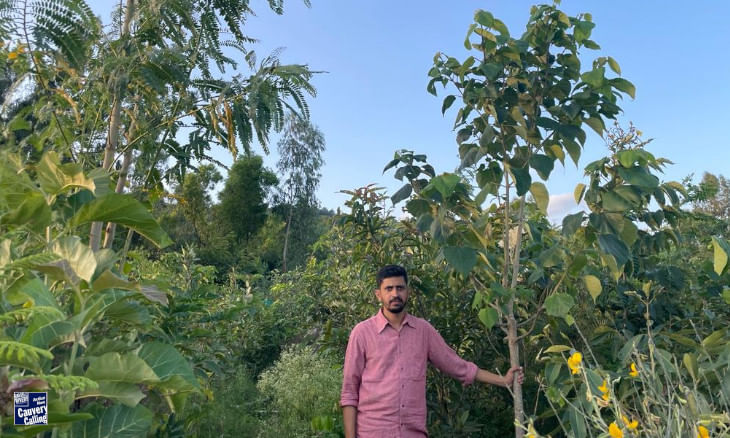
Hemanth's Background
Hemanth Gokhale, a resident of Dasarahalli in the Chikkamagaluru district, embarked on an extraordinary journey with no prior experience in agriculture. He purchased a piece of land that was rocky and devoid of any vegetation. The stark barrenness of the land, however, didn't deter Hemanth; it inspired him.
Discovery of Tree-Based Agriculture
Hemanth was drawn to the concept of tree-based agriculture, a sustainable practice that integrates tree planting with farming. There were no trees on this land at all, he recalls. Yet, he envisioned a land thriving with trees, resembling a forest, where farming could be practised sustainably.
Challenges Faced
The challenges were manifold. The land, characterised by red soil mixed with stones, posed significant difficulties for conventional farming. Its proximity to the forest boundary also heightened the risk of animal interference.
Assistance from Cauvery Calling
It was at this point that the Cauvery Calling team stepped in to guide Hemanth. They provided invaluable advice on suitable plant species, improving soil fertility, managing flood risks and helping him to get saplings. Their expertise was crucial in navigating the challenges of transforming the land.
Implementation of Miyawaki Method
Hemanth adopted the Miyawaki method, a technique that promotes the rapid growth of native trees with minimal maintenance. We had to grow around 900 plants here, he says, describing the dense plantation over a 350 square meter area. This method was ideal for maximizing green cover in a small space.
Results and Community Impact
The transformation of Hemanth's land is nothing short of remarkable. From a barren rocky terrain to a lush mini-forest, the change is a testament to the power of sustainable agriculture. Hemanth's project has not only revitalized his land but also inspired his community. Discussions about the Miyawaki forest concept have become commonplace, as more people show interest in this sustainable approach.
Conclusion
Hemanth Gokhale's journey is a shining example of how individual initiative, coupled with expert guidance and a commitment to sustainability, can lead to remarkable environmental transformations. His story showcases the potential of tree-based agriculture in revitalizing land and contributing to ecological balance.
Call to Action
We invite our readers to explore the possibilities of tree-based agriculture and to consider supporting initiatives like Cauvery Calling. Together, we can make a difference in our communities and for our planet.
Related Stories
Spirited Warriors on the Ground - On the Farmers’ Trail of Cauvery Calling
13 Aug 2019
01:41 pm
From spirited hearts of volunteers, the stark and harsh realities of those who feed us pour forth.
Resilience Beyond Reason: On the Farmers’ Trail of Cauvery Calling
18 Aug 2019
11:02 am
Read the stories of Subramanyam and Sabarinatham and see how underneath their inspiring spirits, there is a call for help.
What Happens When A Farmer Becomes Poetic! On the Farmers' Trail of Cauvery Calling
19 Aug 2019
10:38 am
Here’s the interesting message that farmer Vanambadi wants to share with all the farmers of Tamil Nadu. You don’t want to miss his poetic flair!
Keep In Touch
Get the latest Cauvery Calling updates delivered to your inbox.