
>
Cauvery Calling>
Blogs>
Solution>
Increasing Green Cover Is The Only Way To Make Rivers Flow In Tropical Lands
Share
Increasing Green Cover Is The Only Way To Make Rivers Flow In Tropical Lands
Solution

21 Nov 2019

02:38 pm
Dr. Mohit Gera, IFS officer and Director of the Institute of Forest Genetics & Tree Breeding explains that the only way to make the Cauvery flow perenially, is to bring back the trees in the river basin.
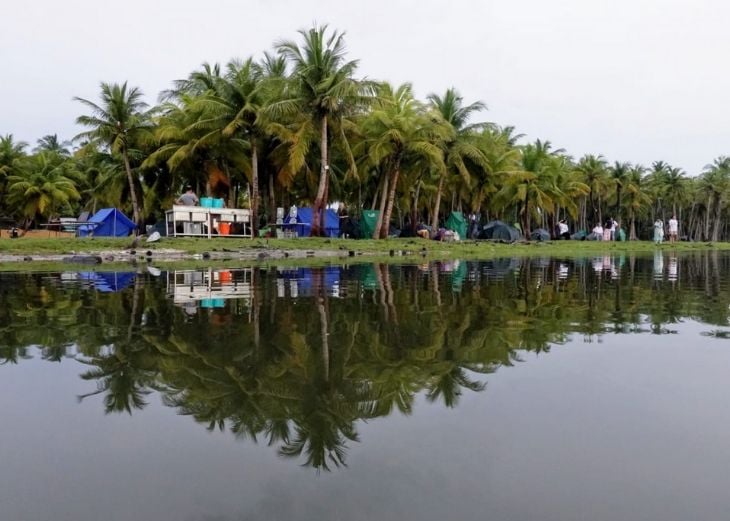
There is a very intricate connection between forests and water. In fact, at the global level 75 per cent of accessible freshwater is provided by forested watersheds and wetlands.
And wherever there are forests, those soils are rich, living soils because of the trees. If rain falls directly on the soil, it will dislodge the soil and torrents of mud will enter the river systems and streams.
This is why we are seeing browning of rivers that were crystal clear earlier. Tree canopies are the only viable solution to dissipate and regulate this energy from precipitation, in a very useful manner.
When you closely observe how trees and water quality and availability are connected, you can’t help but marvel at Nature’s intelligence. It is as if trees have been created to act as natural regulators.
Tree foliage checks the speed of falling precipitation and starts the function of humus, the organically rich compost of degenerated leaves, twigs, seeds, flowers. Humus has a sponge-like capacity to absorb water but where it gets really interesting is how it regulates the water flow into rivers, streams and aquifers.
Groundwater, because of gravity, eventually flows into rivers, in a matter of a few hours; and it takes along with it the topsoil — this is not good news. But when the fall of precipitation is broken by trees, the infiltration into rivers can take weeks and sometimes months, trickling down in the form of drops into the main river system depending on the path it travels.
The river system is slowly recharged long after the rains, keeping rivers and streams healthy and alive.
Forests and water have three kinds of connections. First, trees enhance water quality. The humus we spoke about earlier is one of Nature’s best filtration mechanisms and can filter sediments and constituents of chemical fertilizers. This means only clean water enters river systems.
Second, and most significant is water regulation. Compared to a couple of hours of rainfall run-off in the open soil system, the forest system regulates the water for weeks and months together, so the duration of flow is enhanced.
This is why we see streams and rivers around thick forests flowing even in summer while water bodies around barren land only fill during monsoons.
And the third is evapotranspiration, the process by which trees release moisture into the atmosphere which condenses and falls back as rain.
That’s why riparian forests are very important.
When we remove trees from river basins we’re messing with a very delicately balanced natural system. We can see this with any of the depleting rivers in India. Let’s take the example of Cauvery.
Historically, Cauvery was flowing perennially and the water was clean. That was when the river basin had a thick tree cover. But now, there are months when Cauvery does not reach the ocean.
These are not changes we can fix easily. If we rip these systems apart, Nature will make us pay the price.
Cauvery has 21 tributaries — all of them have to flow all year round for Cauvery to flow again as a perennial river. And the only way to make them flow is to bring back the trees.
Dr. Mohit Gera, IFS, is the Director of the Institute of Forest Genetics & Tree Breeding. He was a Senior Fellow/Director at The Energy and Resources Institute (TERI) and was also a Member Secretary of the J&K State Pollution Control Board. Dr. Gera is an IFS officer of the J&K cadre and has published several award winning research papers in his area of expertise. He can be contacted at [email protected]
Credit: This article was originally published in Swarajyamag.com
Tags
Related Stories
Mr.D.N Narasimha Raju speaks on Cauvery Calling
25 Nov 2019
09:57 am
"Cauvery Calling will set an example for all tropical regions," says Mr. D.N. Narasimha Raju, Director, TERI
Sandalwood Cultivation - Common Questions Answered By Expert Farmer
11 Sept 2023
10:12 am
Mr. Duraisamy, a resident of Palladam, Muthaandipalayam, has 18 years of experience in cultivating sandalwood trees. In this video, he shares his knowledge and expertise in answering some of the most common questions related to sandalwood cultivation.
Keep In Touch
Get the latest Cauvery Calling updates delivered to your inbox.