



COP30: A Turning Point for Climate Action—but Agriculture and Soils Still Left Behind
Dec 5, 2025
COP30 will likely be remembered as one of the most consequential climate gatherings of the last decade. For the first time, several global indicators suggest that the curve of planetary heating may finally be bending downward. Years of policy shifts, sectoral transformation, and civic pressure are beginning to make an imprint on global emissions trajectories.

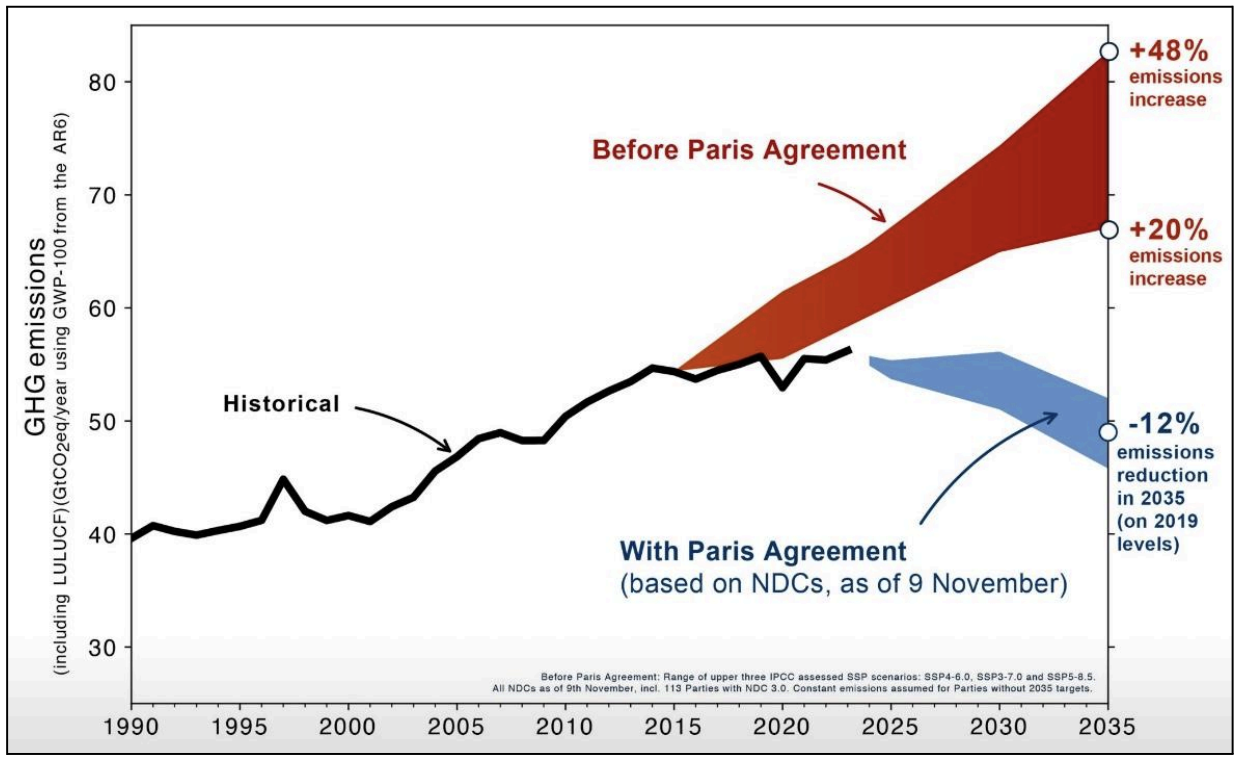
Image Source: UNFCCC, 2025
Yet even this moment of cautious optimism came with a stark warning. At COP30, Prof. Johan Rockström reminded delegates that the remaining carbon budget for keeping 1.5 °C within reach will be entirely exhausted in three to four years. To avoid locking in irreversible tipping points in the Amazon, Greenland ice sheet, and ocean circulation, global emissions must start falling by at least 5% every year starting in 2026.
The trend is improving, but the slope is nowhere near steep enough. The window is not simply narrow — it is almost shut.
The Brazilian Presidency & the Action Agenda: Organizing the Global Response
One of the most constructive outcomes of COP30 came from the Brazilian Presidency. Rather than producing yet another high-level declaration, Brazil chose instead to bring coherence to the sprawling ecosystem of climate commitments. More than 480 voluntary initiatives from businesses, civil society, cities, and financial actors were consolidated into 117 Plans to Accelerate Solutions, organized across six Action Agenda Axes. Each axis focuses on a major pillar of the global transition.
The Six Axes of the COP30 Action Agenda & Standout Commitments
1. Axis 1 — Transitioning Energy, Industry & Transport
Standout commitment: Nearly USD 1 trillion pledged to expand renewable energy, modernize global grids, and accelerate storage deployment this decade.
2. Axis 2 — Stewarding Forests, Oceans & Biodiversity
Standout commitment: Coordinated protection and restoration across “hundreds of millions of hectares” of forest, land, and ocean ecosystems.
3. Axis 3 — Transforming Agriculture & Food Systems
Standout early numbers:
○ USD 9 billion invested,
○ 210 million hectares tied to restoration initiatives,
○ 12 million farmers reached across 110+ countries.
A start — but still far from the scale required.
4. Axis 4 — Building Resilience for Cities, Infrastructure & Water
Standout target: Strengthening climate resilience for over 400 million people by 2030.
5. Axis 5 — Advancing Human & Social Development
Standout focus: Protecting lives, health systems, and vulnerable populations through integrated climate-risk planning.
6. Axis 6 — Enablers & Accelerators (Finance, Technology, Capacity-Building)
Standout contribution: Coordinating finance, innovation, and implementation capacity to unlock system-wide action.
Together, these axes offer something the UNFCCC has historically lacked: a coherent, measurable, multi-sectoral action architecture. While the Action Agenda brings clarity, specific sectors still lag far behind — particularly agriculture, soils, and food systems.
The Climate Discourse on Soil, Food & Agriculture Systems
Conversation on agriculture and soils now advances along two parallel tracks:
1. Formal negotiations
2. Non-state climate action.
Progress under each tells a very different story.
TRACK 1 — Formal Negotiations: Between Stagnation and First Steps
The Sharm el-Sheikh Joint Work (SSJW): Little Movement, Growing Concern
The SSJW is the only official negotiation track addressing agriculture and food systems. But progress at COP30 was disappointing:
● Week 1 talks failed to reach consensus.
● The Presidency did not allow talks to continue into Week 2.
● As a result, the agenda item closed with no outcome, delaying all progress until at least SB64 in June.
Given the SSJW’s mandate ends in 2026, the process is already in its third year, yet still mired in basic discussions. At this pace, the working group risks ending without delivering a single concrete action.
What the Subsidiary Bodies Identified
SB62 and SB63 highlighted three persistent gaps:
● Finance gap: unclear volumes, sources, and mechanisms for agriculture-focused climate finance.
● Planning gap: difficulty integrating food systems into national climate plans and value chains.
● Data/MRV gap: weak measurement systems undermine evidence-based action.
SB63 acknowledged that closing finance gaps requires scaled, accessible funding, but no structural solutions emerged.
The Standing Committee on Finance (SCF): A Long-Overdue Inclusion
The SCF, responsible for guiding the New Collective Quantified Goal (NCQG) and adaptation finance, held a historic forum in 2025 — the first time in its 15-year history it dedicated an event to agriculture and food systems. This represents a long-overdue recognition: soils and food systems are central to climate stability.
But the SCF is still in preliminary stages. As its own report notes, the committee has only just begun acknowledging the need for climate finance to flow into agriculture — with no consideration yet of mechanisms, governance, scale, or delivery pathways. This means financing for land, soils, and regenerative agriculture remains structurally absent from global climate architecture.
TRACK 2 — Climate Action: The Promise and Limits of Axis 3
The Action Agenda’s Axis 3 presents the most structured attempt to organize climate action in agriculture and food systems.
Early commitments are encouraging:
● USD 9 billion in investment,
● 210 million hectares connected to restoration work,
● 12 million farmers reached.
These numbers demonstrate momentum — but not ambition. Compared to the trillion-dollar commitments in clean energy, agriculture and soil systems remain dramatically underfunded.
The Bottom Line: USD 9 Billion Is Nowhere Near Enough
Despite early promises under Axis 3, the reality is stark:
USD 9 billion is an order of magnitude too small to unlock the true climate potential of soils.
Soils are the largest terrestrial carbon sink on Earth. If restored and managed regeneratively, they could address at least 27% of the climate challenge through carbon sequestration, water retention, biodiversity recovery, and resilience-building.
Underfunding this sector has three consequences:
● Soils continue emitting rather than storing carbon.
● Agriculture remains a driver of climate instability instead of a solution.
● The cost of restoring degraded land and mitigating climate change exponentially increases every year we delay.
Without dedicated financing — clear mechanisms, accessible pathways, and large-scale investment — agriculture will remain structurally locked out of climate solutions.
Conclusion
COP30 delivered meaningful advances: better coordination, renewed political commitment, and a clearer architecture for system-wide action. But it also exposed a critical fault line — the persistent marginalization of soils, land, and agricultural systems in climate finance and climate policy.
If the world continues to underinvest in the very ecosystems that stabilize the climate, we will face rising costs, rising losses, and rising risks.
To truly keep 1.5 °C alive, the climate system must finally recognise soil and land restoration not as a peripheral concern, but as one of the central pillars of global climate stability.

நாம் இதனை நிகழச்செய்வோம்!